
Einaudi Center for International Studies
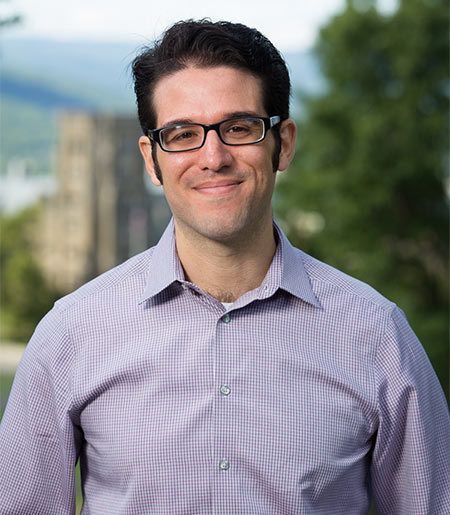
"Embodied Cartographies: Ethnicity, Personhood, and Place in the Prehispanic Andes," by Matthew Velasco, LASP Weekly Seminar Series
March 29, 2021
12:00 pm
Spanish colonial accounts of the former Inka Empire chart a vast political landscape of diverse ethnic polities that were differentiated by language, dress, and custom. The ethno-territorial maps derived from these accounts have significantly shaped how archaeologists describe and classify stylistic variation in cultural practices. Specifically, archaeologists have come to view cranial modification, the intentional reshaping of the head during infancy, as a quintessentially ethnic emblem that marked one “kind of people” as distinct from another. This approach unwittingly adopts a view from the outside and above—outside because it makes an exotic practice legible through the Western concept of ethnicity; above because it reinscribes categories of difference historically politicized by the state. Shifting the focus from ethnic symbol to embodied subject, my research attempts an archaeological reconstruction of cranial modification as it was experienced by those who practiced it. Through a richly contextualized case study integrating historical documentation, archaeological evidence, and biocultural data from human skeletal remains, I show how head shaping practices intersected gender, kinship, and status identities and contributed to emerging social inequalities in the era before Inka imperial expansion (1000 – 1450 CE). Such diversity in lived experience is masked by ethno-territorial models that present the ethnic group as a homogenous unit. In their place, indigenous Andean understandings of personhood provide a better account of how social difference operated on the ground and became naturalized in the body.
Matthew Velasco is an anthropological bioarchaeologist who studies ancient populations of the Peruvian Andes through the analysis of their skeletal remains. His research explores the emergence of novel ethnic identities and cultural traditions during the era preceding and encompassing Inka imperial expansion in the 15th century. To explore how these dynamic social transformations impacted the lived experience of the body and its treatment at death, he analyzes and interprets indicators of social identity, biological relatedness, diet, and health status written on the human skeleton.
His teaching spans the humanities, social sciences, and physical sciences, covering topics such as mortuary practice, human skeletal anatomy, forensic anthropology, and human evolution. He is currently developing undergraduate courses and graduate seminars on bioarchaeology, the archaeology of death and dying, and the embodiment of inequality.
Additional Information
Program
Einaudi Center for International Studies
Latin American and Caribbean Studies
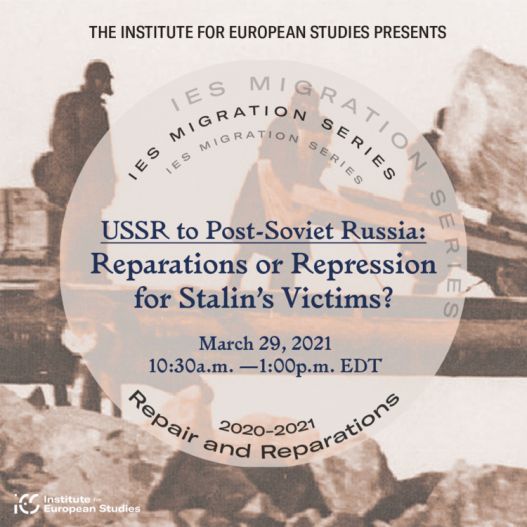
USSR to Post-Soviet Russia: Reparations or Repression for Stalin’s Victims?
March 29, 2021
10:30 am
This panel will explore proposals in the early post-Soviet period to honor the memory of, and perhaps provide reparations to, the victims of Stalinist repression. They were replaced by official government efforts to rehabilitate Stalin’s reputation and even rewrite the history of World War II. Organizations such as Memorial, formed to maintain the memory of Stalin’s crimes, have been declared “foreign agents” and obliged to curb their activities. This event brings together an interdisciplinary panel of experts to discuss the initiatives and missed opportunities in post-Soviet reparations.
Speakers:
Ivan Kurilla | European University at St. PetersburgNina Tumarkin | Wellesley CollegeEgle Rindzevičiūtė| University LondonNikolay Epplee | Independent Researcher
Moderated by Matthew Evangelista | Cornell University
The panel is sponsored by the IES of Einaudi Center for International Studies at Cornell University. It is organized as part of the IES Migration Series for its AY 2020-21 theme Repair and Reparations. You may find information about the past events including their video recordings here: https://einaudi.cornell.edu/programs/institute-european-studies/events/….
Additional Information
Program
Institute for European Studies
Einaudi Center for International Studies
The Hand
April 1, 2021
12:01 am
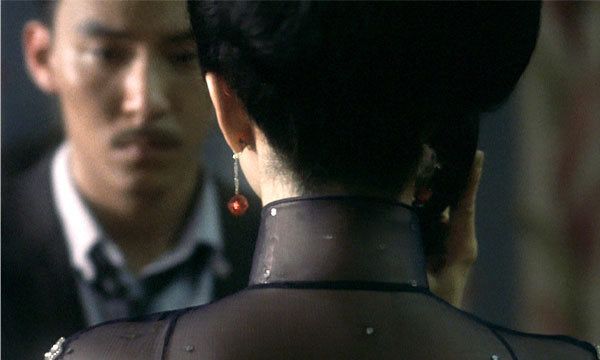
Ithaca Premiere>2004 > Hong Kong > Directed by Wong Kar Wai
With Chang Chen, Gong Li
Originally conceived for the omnibus film Eros, this film - presented in this retrospective for the first time in its extended cut - tells the tale of Zhang, a shy tailor's assistant enraptured by a mysterious client, Miss Hua. A hypnotic tale of obsession, repression, and class divisions, The Hand finds Wong Kar Wai continuing to transition from the frenetic, energized style of his earlier films into a register that is lush with romantic grandeur. In Mandarin. Subtitled. Cosponsored with the East Asia Program.
56 min
We will start taking reservations one week in advance of a film's first play date.
Reservations can be made here:
https://cinema.cornell.edu/virtual-cinema-order-form
Additional Information
Program
Einaudi Center for International Studies
East Asia Program
"The River and The Wall" panel discussion
March 23, 2021
12:00 pm
Film Overview
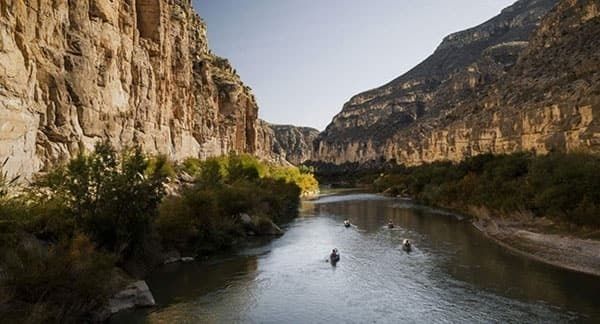
The documentary film The River and the Wall follows five friends on an immersive adventure through the unknown wilds of the Texas borderlands as they travel 1200 miles from El Paso to the Gulf of Mexico on horses, mountain bikes, and canoes. Conservation filmmaker Ben Masters realizes the urgency of documenting the last remaining wilderness in Texas as the threat of new border wall construction looms ahead. Masters recruits NatGeo Explorer Filipe DeAndrade, ornithologist Heather Mackey, river guide Austin Alvarado, and conservationist Jay Kleberg to join him on the two-and-a-half-month journey down 1,200 miles of the U.S.-Mexico border. They set out to document the borderlands and explore the potential impacts of a wall on the natural environment, but as the wilderness gives way to the more populated and heavily trafficked Lower Rio Grande Valley, they come face-to-face with the human side of the immigration debate and enter uncharted emotional waters. The film is in English, with occasional Spanish subtitled in English. Running time: 1 hr 37 min. Streaming details and more information.
Panelists:
Heather Mackey '10, cast member and ecologist. Heather completed a BS in Ecology and Evolutionary Biology at Cornell University. She has worked as a field biologist and conducted conservation research in a variety of remote locations including Kodiak Island, Alaska and the Galapagos Islands, as well as the Australian rainforest where she contributed to research on the behavior of the Satin Bowerbird. It wasn’t until she began her MS research at California State University Los Angeles that she discovered the wonderment of West Texas. Through her two seasons on the Rio Grande researching the impact of riparian restoration on the bird and butterfly communities she’s developed a deep appreciation for the wildlife and the people of West Texas.
Debra A. Castillo is Stephen H. Weiss Presidential Fellow, Emerson Hinchliff Professor of Hispanic Studies, and Professor of Comparative Literature at Cornell University. She is past president of the international Latin American Studies Association. She specializes in contemporary narrative and performance from the Spanish-speaking world (including the United States), gender studies, comparative border studies, and cultural theory. Her most recent books include Mexican Public Intellectuals (with Stuart Day), South of the Future: Speculative Biotechnologies and Care Markets in South Asia and Latin America (with Anindita Banerjee) and The Scholar as Human (with Anna Sims Bartel). She has a longstanding collaboration with Teatrotaller, the Cornell Latino/a theater troupe.
Sergio Garcia-Rios, Assistant Professor of Government and Latina/o Studies, Cornell University. Sergio was born and raised in Durango, México, "but I consider El Paso, TX my second home, a fronterizo by choice." His research investigates the formation and transformation of Latino identities as well as the political implications of these transformations. Other academic interests include issues related to Latinos and the Voting Rights Act, border issues and border research, and the politics of Mexico.
Panel Moderator: John W. Kennedy, PhD Candidate in Romance Studies
Sponsored by the Central New York Humanities Corridor from an award by the Andrew W. Mellon Foundation, Cornell Cinema, Migrations: A Global Grand Challenge (part of Global Cornell), and the Mario Einaudi Center for International Studies.
Additional Information
Program
Einaudi Center for International Studies
Latin American and Caribbean Studies
The River and The Wall
March 25, 2021
12:01 am
2019 > USA > Directed by Ben Masters
With Heather Mackey '10, Ben Masters, Filipe Deandrade, Austin Alvarado, Jay Kleberg
This spectacularly photographed documentary follows five friends on an immersive adventure through the unknown wilds of the Texas borderlands as they travel 1200 miles from El Paso to the Gulf of Mexico on horses, mountain bikes, and canoes. They set out to document the borderlands and explore the potential impacts of a border wall on the natural environment, but as the wilderness gives way to the more populated and heavily trafficked areas, they come face-to-face with the human side of the immigration debate. One of the adventurers is Heather Mackey, who earned her BS in Ecology and Evolutionary Biology from Cornell 2010. She has worked as a field biologist and done conservation research, and spent two seasons on the Rio Grande researching the impact of riparian restoration on bird and butterfly communities. Cosponsored by Cornell's Migrations Initiative and the Einaudi Center. More at theriverandthewall.com
1 hr 49 min
We will start taking reservations one week in advance of a film's first play date.
Reservations can be made here:
https://cinema.cornell.edu/virtual-cinema-order-form
Additional Information
Program
Einaudi Center for International Studies
Latin American and Caribbean Studies
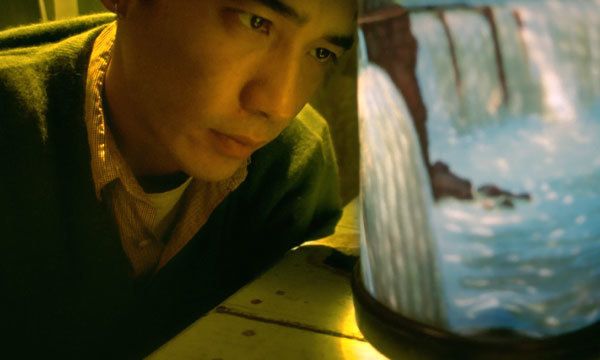
Happy Together
March 25, 2021
12:01 am
1997 > Hong Kong > Directed by Wong Kar Wai
With Tony Leung Chiu-Wai, Leslie Cheung
Wong Kar Wai deals with emotional entrapment in this film that won him the Best Director award at the 1997 Cannes Film Festival. Taking as its subject two gay lovers from Hong Kong spending the last few months of British rule away from home -- in Buenos Aires, Argentina - the film is characteristic of the director, with visuals that grab hold and never let go, and a soundtrack -- a mixture of Astor Piazzola, Frank Zappa and the Turtles -- that is undoubtedly one of the most expressive in years. In Mandarin, Cantonese & Spanish. Subtitled. Cosponsored with the East Asia Program.
1 hr 32 min
We will start taking reservations one week in advance of a film's first play date.
Reservations can be made here:
https://cinema.cornell.edu/virtual-cinema-order-form
Additional Information
Program
Einaudi Center for International Studies
East Asia Program
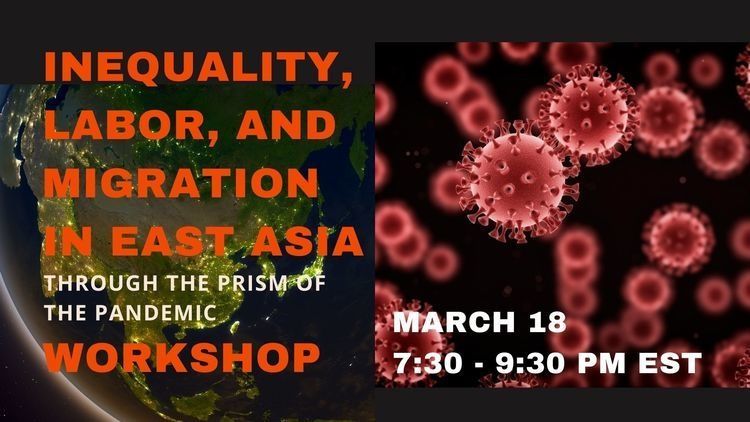
Inequality, Labor, and Migration in East Asia Through the Prism of Global Pandemic Virtual Workshop
March 18, 2021
7:30 pm
Inequality, Labor, and Migration in East Asia
Through the Prism of Global Pandemic Virtual Workshop
Long-standing demographic changes will have serious implications for the nature of work, spatial mobility, and the overall distribution of resources in the countries of East Asia. Has the Coronavirus pandemic seriously affected any of the aforementioned areas and, if so, how? Join us for an inter-and cross-disciplinary workshop that explores the ongoing pandemic and its implications for inequality, labor, and migration in China, Hong Kong, Japan, the Korean peninsula, and Taiwan.
The workshop will begin with introductory remarks before moving to several short (approx. 20 minutes) presentations around the theme and will then conclude with several affinity group breakout rooms to further facilitate in-depth conversations. Participants from all disciplinary backgrounds and career stages are welcome and we especially encourage advanced graduate students, postdoctoral fellows, and fixed-term researchers to both present and participate.
This event is hosted by East Asia Program's core faculty member, Tristan Ivory (International and Comparative Labor, ILR), and Kun Huang, Ph.D. Student (Comparative Literature) - she is also an officer of the Graduate Student Steering Committee (GSSC) of EAP with the generous cooperation in planning from Vivian Shaw (Harvard College Fellow, Department of Sociology, Harvard University) and Sujin Eom (Postdoctoral Fellow, Department of Geography, Dartmouth University) .
Additional Information
Program
Einaudi Center for International Studies
East Asia Program
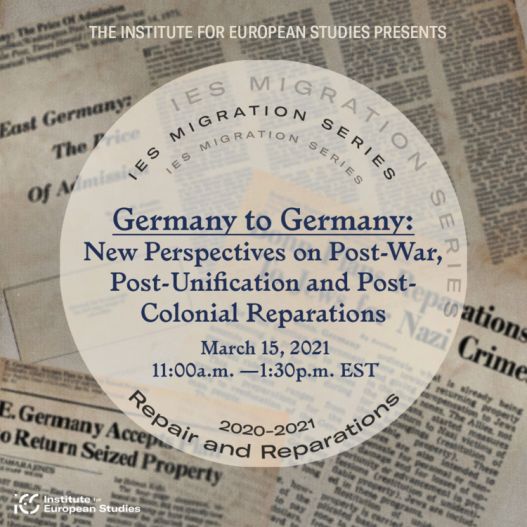
Germany to Germany: New Perspectives on Post-War, Post-Unification and Post-Colonial Reparations
March 15, 2021
11:00 am
This panel will bring together scholars who provide new perspectives on the material and moral reparations of the postcolonial, post-Nazi and post-communist eras in Germany, as well as the significance of these restitutions in serving as models for transitional justice and international law. It will explore both material and moral reparations, such as return and restitution of property that had been confiscated, monetary payments as compensation, and educational steps to take accountability for the past. The panel will not only acknowledge these reparations to ex-citizens and refugees, but also question the limits of established formulas and the lack or inequality of restitutions throughout the history of today’s Germany.
Speakers List:
Ruti Teitel | New York Law SchoolRebecca Boehling | U.S. Holocaust Memorial Museum, University of MarylandNicholas Mulder | Cornell UniversityTiffany Florvil | The University of New MexicoModerated by Esra Akcan | Cornell University
The panel is sponsored by the IES of Einaudi Center for International Studies at Cornell University. It is organized as part of IES’ Migration Series for its AY 2020-21 theme Repair and Reparations. You may find information about the past events including their video recordings here: https://einaudi.cornell.edu/programs/institute-european-studies/events/….
Additional Information
Program
Institute for European Studies
Einaudi Center for International Studies
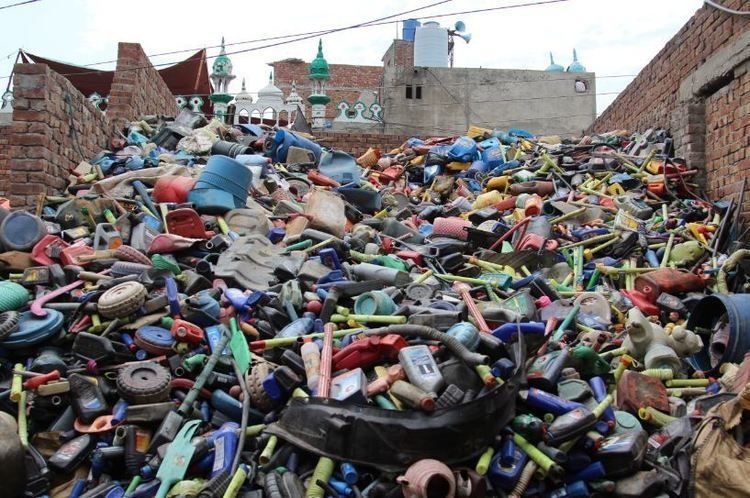
Figures of Surplus: Waste, Informality, and Caste in Urban Pakistan, by Waqas Butt
March 15, 2021
11:00 am
Waste work across South Asia is structured by caste, especially as low or non-caste groups (Dalits) have remained historically dominant in this form of labor. This continues to be true in contemporary Pakistan, where uneven urbanization driven by a consumption-based economy has shifted spatial relations along the lines of caste, class, and religion. Unsurprisingly, during this time, markets for waste materials and work have expanded rapidly, while creating renewed space for kabāṛīan (junkyard owners) and bīopārīan (middlemen or brokers) to enter this line of trade. This talk tracts through spaces—jhuggīān (huts), junkyards, warehouses, furnaces, manufacturing plants—where waste materials are worked with and exchanged, being procured and transformed into resources to be used in remaking commodities. Recent discussions of informality within South Asia have highlighted the contradictory situation faced by labor: excluded from formalized sectors of capitalist economies, relations of work and exchange have emerged to generate surpluses that are simultaneously directed at need and accumulation. By tracing the relations of work and exchange surrounding waste materials, this talk argues that informality undergird more formalized sectors of capitalist economies, uneven urbanization across much of Pakistan, and the reproduction of historical inequalities and interdependencies, in which caste-based forms of difference remain essential.
Waqas H. Butt is an anthropologist at University of Toronto Scarborough whose work focuses on the intersections of caste, labor, infrastructures, and waste in urban Pakistan. Based on long-term ethnographic fieldwork in Lahore and the Punjab, his current book project examines the ways in which waste workers, who are drawn predominantly from low or non-caste (Dalit) groups, have become essential components of urban life through the everyday and intimate workings of waste infrastructures. His research has been funded by the Wenner-Gren Foundation, the American Institute of Pakistan Studies, and the University of California, San Diego. His work has appeared in academic journals such as CITY, American Ethnologist, ILWCH, among others, as well as newspapers and magazines in Pakistan.
Additional Information
Program
Einaudi Center for International Studies
South Asia Program
Three Summers
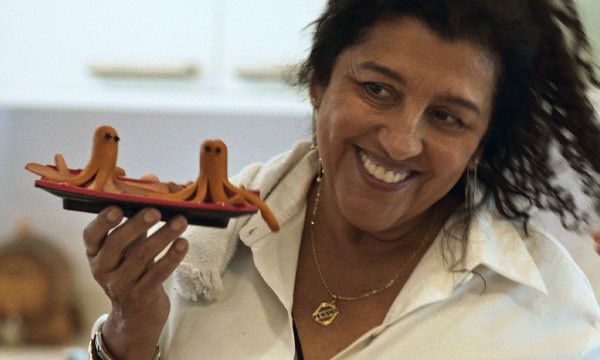
March 18, 2021
12:01 am
Ithaca Premiere>2019 > Brazil > Directed by Sandra Kogut
With Regina Case
"A chaotic class dramedy where the help and the helped wind up switching places, Three Summers (Trs Veres) marks another occasion for Brazilian actress Regina Case (The Second Mother) to shine in the role of a housekeeper trying to overcome stiff social barriers and find her own slice of happiness." (The Hollywood Reporter) In Portuguese. Subtitled. More at www.distribfilmsus.com
1 hr 34 min
We will start taking reservations one week in advance of a film's first play date.
Reservations can be made here:
https://cinema.cornell.edu/virtual-cinema-order-form
Additional Information
Program
Einaudi Center for International Studies