
Einaudi Center for International Studies
Student Info Session: Laidlaw Scholars Program
December 14, 2020
5:00 pm
Additional Information
Program
Einaudi Center for International Studies
Student Info Session: Laidlaw Scholars Program

December 11, 2020
12:00 pm
Join us for a student information session on the Laidlaw Undergraduate Research and Leadership Program this December 11 at 12 p.m. (EST). Open to first- and second-year Cornellians, the program provides generous support for you to carry out internationally-focused research of your choice, develop leadership skills that you put into action, and join a global network of like-minded scholars.
By attending this information session, you will learn more about the programmatic and financial benefits of the Laidlaw Program, how research and leadership are intertwined, how to approach potential faculty research mentors, and the criteria by which applications will be evaluated. Don't miss this opportunity to get all of your questions answered!
Additional Information
Program
Einaudi Center for International Studies
Post-Election Debriefing: The Future of American Democracy (Democracy 20/20)
December 4, 2020
2:00 pm
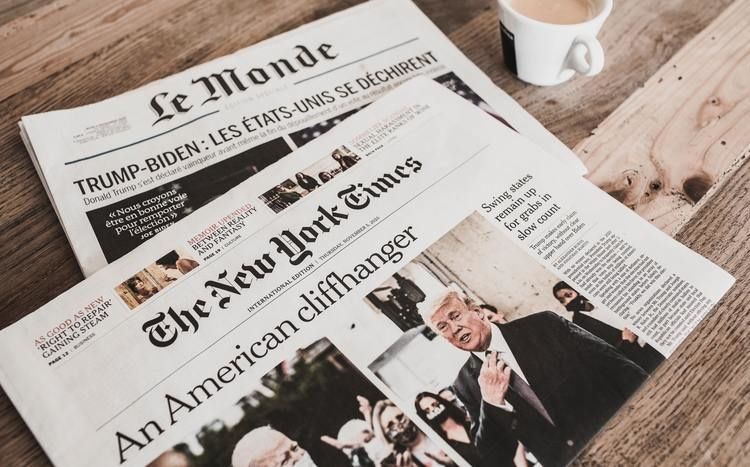
The 2020 presidential election tested the political system and pushed American democracy close to the brink. President Donald J. Trump and many of his supporters continue to claim that the election was beset with fraud.
This Democracy 20/20 panel will look back at a turbulent election cycle and consider how effectively the U.S. political system will weather historic challenges. Some key questions we'll discuss include:
Will the 2020 election ultimately show American democracy to be resilient, or will our political institutions and norms deteriorate toward authoritarianism?How will the Biden presidency shape these trends?What will this election mean for Congress, the states, the Republican and Democratic parties—and the future of American politics?Register now!
Moderator: Robert C. Lieberman is the Krieger-Eisenhower Professor of Political Science at Johns Hopkins University. His most recent book is Four Threats: The Recurring Crises of American Democracy (with Suzanne Mettler).
Panelists
Frances Lee is Professor of Politics and Public Affairs at Princeton University. Her most recent book, coauthored with James M. Curry, is The Limits of Party: Congress and Lawmaking in a Polarized Era.
Christopher S. Parker is the Stuart A. Scheingold Professor of Social Justice and Political Science at the University of Washington, Seattle. Parker is the author of Change They Can’t Believe In: The Tea Party and Reactionary Politics in America.
Paul Pierson is the John Gross Professor of Political Science at the University of California at Berkeley. His most recent book is Let Them Eat Tweets: How the Right Rules in an Age of Extreme Inequality, with Jacob S. Hacker.
Democracy 20/20: A webinar series sponsored by the American Democracy Collaborative, Mario Einaudi Center for International Studies, and the Institute of Politics and Global Affairs
Democracy 20/20 brings together historical and comparative experts to promote deeper understanding of the challenges these unsettling times pose for American democracy. Beginning in June 2020, the series continues through the 2020 election. The stakes for American democracy have never been higher—so please join us for these critical conversations.
Additional Information
Program
Einaudi Center for International Studies
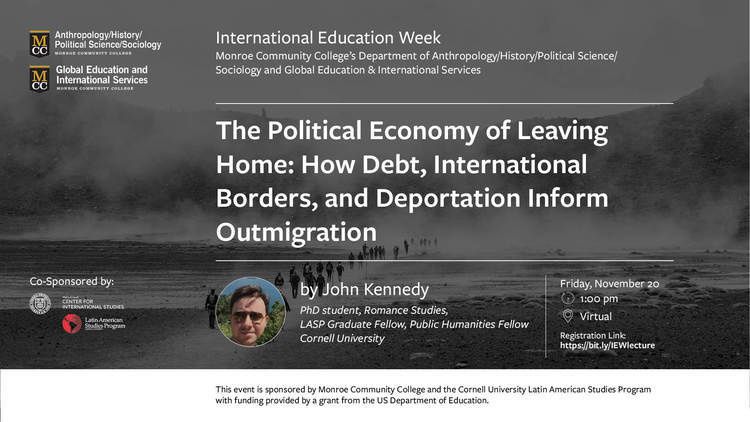
The Political economy of Leaving Home: How Debt, International Borders, and Deportation Inform Outmigration
November 20, 2020
1:00 pm
This talk examines how the financial realities of outmigration from Central America to the United States reinforce return attempts after deportation. Because of the nature of mortgage payments, liens, and debt terms, deported out-migrants often find themselves with little recourse except to try to emigrate North again to find employment. This talk, therefore, examines how prevailing narratives of migration ignore or work around a fundamental economic reality—not one principally of poverty and underemployment but one rather of indebtedness stemming from the significant costs of transnational migration itself.
John Kennedy, is a PhD student, Romance Studies, LASP Graduate Fellow, and a Public Humanities Fellow, Cornell University. John studies migration and its narratives, broadly conceived. He is a recipient of a Fulbright-Hays Fellowship and is currently at work on a project on the financial ecology of migration in Mexico and Central America; he is a first-generation Guatemalan American.
Register at: https://bit.ly/IEWlecture
This event is sponsored by Monroe Community College and the Cornell University Latin American Studies Program with funding provided by a grant from the US Department of Education. Co-sponsored by: MCC’s Department of Anthropology/History/Political Science/Sociology and Global Education & International Services.
Additional Information
Program
Einaudi Center for International Studies
Latin American and Caribbean Studies
Student Info Session: Laidlaw Scholars Program
December 3, 2020
5:00 pm
Join us for a student information session on the Laidlaw Undergraduate Research and Leadership Program. Open to first- and second-year Cornellians, the program provides generous support for students to carry out internationally-focused research of their choice, develop leadership skills to put into action, and join a global network of like-minded scholars.
By attending this information session, you will learn more about the programmatic and financial benefits of the Laidlaw Program, how research and leadership are intertwined, how to approach potential faculty research mentors, and the criteria by which applications will be evaluated. Don't miss this opportunity to get all of your questions answered!
Additional Information
Program
Einaudi Center for International Studies
Mapping Area, Figuring Race and Ethnicity

December 3, 2020
4:30 pm
An online panel discussion considering relations between modern mapping, as a configuration of spatial difference, and modern figurations of race and ethnicity in Japanese Studies.
Hosted by Brett de Bary, Professor Emerita, Asian Studies and Comparative Literature
Participants:
Discussant – John Namjum Kim, Associate Professor, German/Japanese/Comparative Literature, UC RiversideDiscussant – Parisa Vaziri, Assistant Professor of Comparative Literature & Near Eastern Studies, CornellAndrew Harding, Ph.D. candidate in the field of Asian Literature, Religion & Culture,
“Make Zainichi Korean Again: The Allure of the Sovereign Figure in Post-Colonial Japan and Korea”Andrea Mendoza, Assistant Professor of Japanese and Comparative Literature, UC San Diego,
“Toward a Critical Phenomenology of the Transpacific”Dexter Thomas, culture correspondent for Vice News,
“Black Liberation in Japanese Manga: Another Look at Golgo 13”Paul McQuade, Ph.D. candidate in the field of Asian Literature, Religion & Culture,
“Translating Race: Mapping Language and Ethnicity”This panel discussion will consider relations between modern mapping, as a configuration of spatial difference, and modern figurations of race and ethnicity in Japanese Studies, as well as the spatially bounded “Japan” taken to be its object. How do we understand how figures of race and ethnicity, as fundamentally aesthetic constructions without much reference to socio-demographic existences, nevertheless can mobilize such powerful political effects? How is our ability to critically read these figures shaped by geopolitical mappings institutionalized in postwar Area Studies? How do we historicize the multiple distinctions between “interiority” and “exteriority” these mappings enable? Panelists will propose and discuss possible approaches to these questions.
Additional Information
Program
Einaudi Center for International Studies
East Asia Program
Cornell Blockchain Creating Digital Currency

CRADLE Leader Advises the Student Club
Blockchain adviser Robert Hockett codirects Einaudi's CRADLE initiative and development, law, and economics research theme. #IEW2020
Additional Information
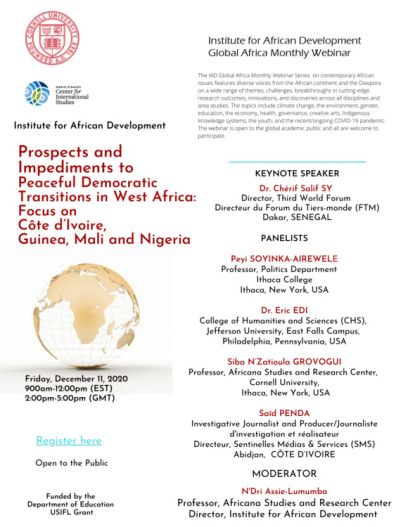
Institute for African Development Global Africa Monthly Webinar Series: Prospects and Impediments to Peaceful Democratic Transitions in West Africa: Focus on Côte d’Ivoire, Guinea, Mali and Nigeria
December 11, 2020
9:00 am
December 11, 900am-12:00pm (EST)/2:00pm-5:00pm (GMT)
This webinar will focus on the geo-politics of the democratic process in selected members of the Economic Community of West African States (ECOWAS). Scholars, members of political organization, practitioners and civil society representatives will share their insights and provide forward-looking perspectives toward social progress in the West African region.
Additional Information
Program
Einaudi Center for International Studies
Institute for African Development
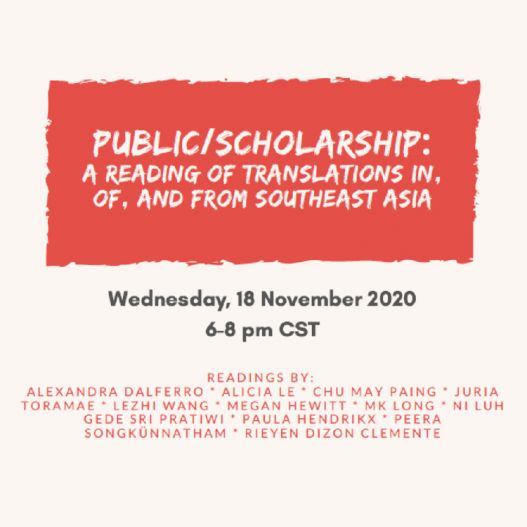
PUBLIC/SCHOLARSHIP: A Reading of Translations in, of, and from Southeast Asia
November 19, 2020
7:00 pm
Since September, approximately thirty graduate students working inside and outside the university around the world met every other week to read and think critically and politically about translation and movement in language in and in opposition to Southeast Asian Studies. How do the colonial, imperial and Cold War legacies in the field shape knowledge, and how might we resist it? What are the potential places of translation in a scholarly life and in a public life, and how do they intersect and diverge? Simultaneously, we circulated and workshopped our own translations of poems, short stories, archival documents, journal articles, and dissident manifestos with one another. In this reading, members of the workshop share their translations with you.
Readings by: alexandra dalferro, Alicia Le, Chu May Paing, Juria Toramae, Lezhi Wang, Megan Hewitt, MK Long, Ni Luh Gede Sri Pratiwi, Paula Hendrikx, Peera Songkünnatham, Rieyen Dizon Clemente
With support from the Department of Asian Languages and Cultures and the Center for Southeast Asian Studies at UW-Madison and the GETSEA Consortium.
Additional Information
Program
Einaudi Center for International Studies
Southeast Asia Program
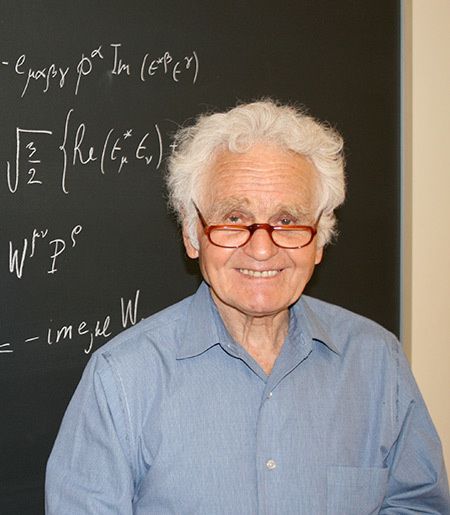
Remembering Professor Yuri Orlov: Physicist, Human Rights Activist, Soviet Dissident
November 18, 2020
10:00 am
Join a webcast as some of the world’s most prominent human-rights leaders, along with his physicist colleagues and students, gather to honor Professor Yuri Orlov.
Renowned dissident Yuri Orlov, professor emeritus, died at age 96 in September. Born in Moscow, Orlov pursued a distinguished career in physics until his activities in support of human rights led to his arrest by the KGB, years of prison and labor camp, and Siberian exile. The Moscow Helsinki Group, which he founded, inspired human-rights monitoring groups throughout the world, including Human Rights Watch. Deported to the United States in 1986, he continued his human rights activity and, at Cornell, resumed his physics research and later taught physics and human rights. He retired as Professor Emeritus of Physics at the age of 91.
Learn more about Professor Orlov's life and legacy—and what it means to be an activist and dissident— by attending this special remembrance.
Part of International Education Week #IEW2020 with Global Cornell.
Co-sponsored by the Reppy Institute for Peace and Conflict Studies at the Mario Einuadi Center for Interational Studies, the Migration and Human Rights Program at Cornell Law School, and the National Security Archives.
Additional Information
Program
Einaudi Center for International Studies
Reppy Institute for Peace and Conflict Studies