
Einaudi Center for International Studies
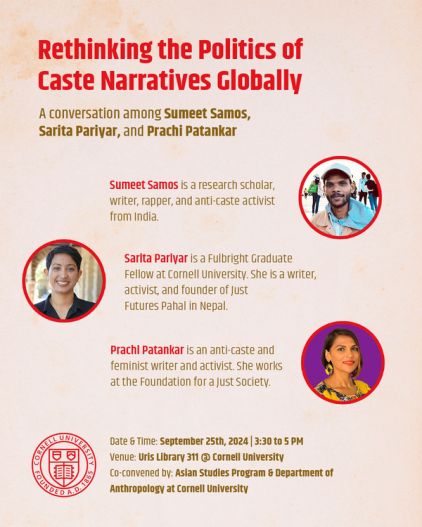
Rethinking the Politics of Caste Narratives Globally
September 25, 2024
3:30 pm
Uris Library, 311
A conversation among Sumeet Samos, Sarita Pariyar, and Prachi Patankar
Sumeet Samos is a research scholar, writer, rapper, and anti-caste activist from India.
Sarita Pariyar is a Fulbright Graduate Fellow at Cornell University. She is a writer, activist, and founder of Just Futures Pahal in Nepal.
Prachi Patankar is an anti-caste and feminist writer and activist. She works at the Foundation for a Just Society.
Additional Information
Program
Einaudi Center for International Studies
South Asia Program
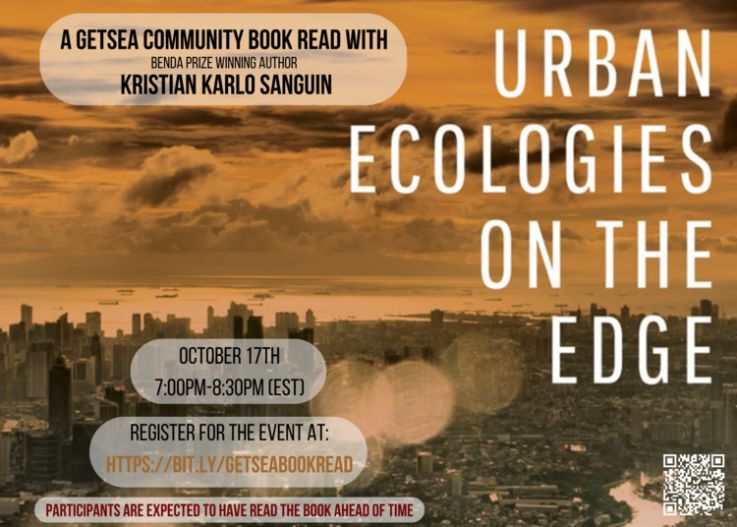
Urban Ecologies on the Edge: A GETSEA Community Book Read by Kristian Karlo Saguin
October 16, 2024
7:00 pm
A community book read with Kristian Karlo Saguin, author of Urban Ecologies on the Edge: Making Manila’s Resource Frontier and winner of the 2024 Benda Prize.
Register here for the Zoom link. Participants are expected to have read the book.
Urban Ecologies on the Edge offers an innovative and theoretically groundbreaking perspective on the production and maintenance of new resource frontiers on the edge of a rapidly expanding city in the Global South. Using the case study of Laguna Lake in Metro Manila, Saguin demonstrates with methodological versatility the dynamic relationship between economic development and environmental management as diverse stakeholders attempt to access and control commodity flows within chains of urban provisioning. Through meticulous storytelling, the book artfully traces the intertwined socioecologies of floods, food, fish, fisherfolk, and infrastructures. With precision and clarity, it reveals how human and nonhuman actors contend for diverse and increasingly exhausted resources, while confronting risk and precarity that manifest in conflicting visions of the future sustainability of the lake and surrounding city.
Additional Information
Program
Einaudi Center for International Studies
Southeast Asia Program
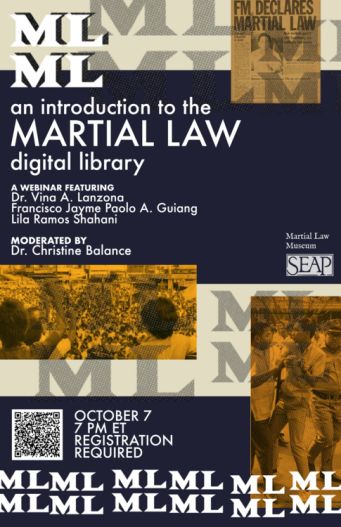
Introduction to the Martial Law Digital Library
October 7, 2024
7:00 pm
A webinar featuring Vina A. Lanzona, Francisco Jayme Paolo A. Guiang, and Lila Ramos Shahani, moderated by Christine Balance and organized by the Southeast Asia Digital Library.
Vina A. Lanzona: "Origins and Vision of the Martial Law Library: Navigating the Difficult Philippine Past"
Associate Professor in History and former director of the Center for Philippine Studies at the University of Hawaii at Manoa
In this talk, Vina Lanzona will share the beginnings of the idea of a digital library of Martial Law materials, as well as the vision of the project. She will outline the major challenges as well accomplishments of this collaborative project that spans across countries, oceans and continents. Central to her presentation is to show how to navigate the website, taking all of us into a unique journey into this painful and controversial period in Philippine history.
Francisco Jayme Paolo A. Guiang: “Marcosian propaganda as fascist propaganda: Myth-making and historical distortions in the 21st century”
Assistant Professor at the Department of History, University of the Philippines Diliman
In this talk, Jio Guiang argues that Marcosian propaganda is a form of fascist propaganda that utilizes networked disinformation as a means to manipulate public discourse and generate mass support. In recent years, social media platforms have become conduits for political myth-making and historical distortions that ultimately subscribe to the playbook of “fascist propaganda” in the Philippines. Thus, this presentation will show examples of social media materials so as to reveal how some forces within the Philippine political establishment have deployed this type of propaganda to systematically weaponize disinformation and gain public support—a tactic that had been proven effective for the Rodrigo Duterte and the Ferdinand “Bongbong” Marcos Jr. regimes.
Lila Ramos Shahani: "Grieving the ungrievable: Trauma and Memory during Martial Law"
Expert Member of two International Scientific Committees of the International Council on Monuments and Sites (ICOMOS), where she specializes in the Interpretation and Presentation of Cultural Heritage Sites (ICIP) and Intangible Cultural Heritage (ICICH)
If memorials can be described as the performance of memory, which stories do they privilege, and which do they eclipse or deliberately erase altogether? Memorials (monuments, historical markers, art, texts) can also be seen as the materialization of certain stories. But memorialization paradoxically preserves, even as it represses, memory itself. It is this dialectical relationship between memory and memorialization, one that is unending and open-ended, that I seek to unpack. I look at the relationship between grieving and trauma -- how the two are inseparable yet unresolvable -- in relation to narratives of torture by survivors of Martial Law in the Philippines. Following Judith Butler’s notion of “grievability,” I ask: whose lives (and stories) have been deemed to be grievable, whose have not, and how have these calibrations influenced the way Martial Law has been commemorated? Based on first-hand interviews with survivors and numerous affidavits, I examine the relative absence of memorialization of Filipino Muslims (“Moros”), particularly women, whenever the brutal record of the Marcos regime is recalled.
Additional Information
Program
Einaudi Center for International Studies
Southeast Asia Program
MexicanEast Conference: Transit

September 21, 2024
9:00 am
A. D. White House
The 2024 MexicanEast conference, held at Cornell University from September 20-21, 2024, brings scholars together to discuss transit through the lens of Mexican cultural studies. We welcome discussion about migration, movement, transition, trade, and trans and queer issues, as well as any other meaningful engagement with the topic of transit.
Additional Information
Program
Einaudi Center for International Studies
Latin American and Caribbean Studies
Migrations Program
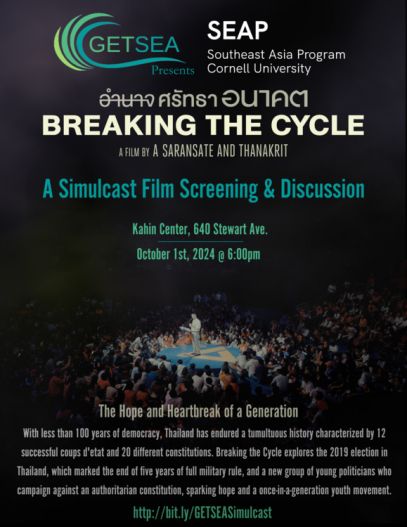
GETSEA Simulcast Film Screening of "Breaking the Cycle"
October 1, 2024
6:00 pm
Kahin Center
Breaking the Cycle captures the political awakening among Thais after the rise and fall of Thanathorn, a young politician who calls to end the cycle of coups d’etat. The film explores the 2019 election in Thailand, which marked the end of five years of full military rule and a new group of young politicians who campaign against an authoritarian constitution, sparking hope and a once-in-a-generation youth movement.
Screenings of the film will be held simultaneously at nineteen (19) university campuses across North America. Following the screenings, each campus will come together via Zoom for a discussion with the filmmakers, Aekaphong Saransate and Thanakrit Duangmaneeporn.
The Southeast Asia Program will host a screening at the Kahin Center, 640 Stewart Ave. A virtual-only option for the event will take place via Zoom at https://bit.ly/BreakingTheCycleSimulcast.
Additional Information
Program
Einaudi Center for International Studies
Southeast Asia Program
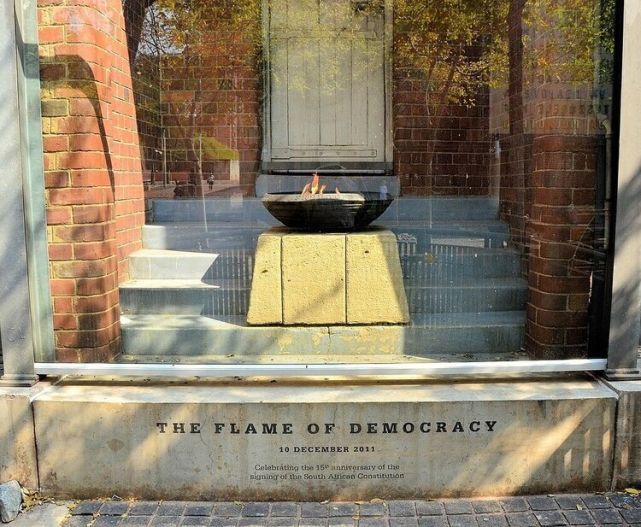
IAD Seminar: Constitution-making in Africa: Prospects and Challenges
September 26, 2024
11:15 am
Ives Hall, 109
Good governance is contingent on the development of political systems that gives citizens ownership of the political process.
Additional Information
Program
Einaudi Center for International Studies
Institute for African Development
Across the Archives: Uncovering Hidden Actors in Anthropology Collections
November 21, 2024
10:00 am
A SEADL webinar featuring Amrina Rosyada and I Gde Agus Darma Putra, hosted by Emily Zinger, Southeast Asia Digital Librarian, Kroch Asia Collections Cornell University Library.
How can we use archives to build a narrative about behind-the-scene actors in research?
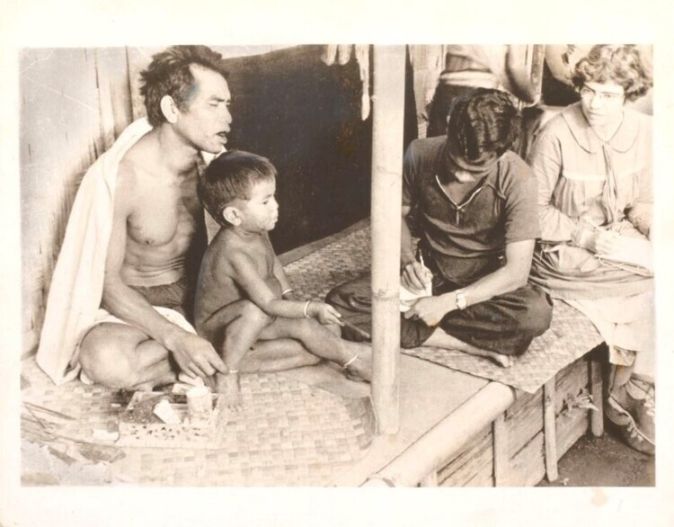
From the US to Indonesia, local research assistants have helped anthropologists with navigating their field sites. However, in the history of the discipline, many of their contributions and life histories remain obscure. In this webinar, we will discuss how we can use archives to highlight the contributions of local research assistants in knowledge production. Rosyada will focus on her research on I Made Kaler, superstar anthropologist Margaret Mead’s Balinese “native secretary” during her historically important fieldwork in Bali, Indonesia (1936 – 1939). Drawing from archives at the Library of Congress and the American Museum of Natural History, her research finds that Made Kaler was tremendously involved in Margaret Mead’s research through intellectual, language training, and domestic labor. Putra, who is fom Bali and translated Made Kaler’s archives into Bahasa Indonesia, will discuss how we can treat archives as “alive” by reflecting on his experience in exploring the traces of Made Kaler’s life in modern-day Bali. We hope to invite you to a conversation about the opportunities and challenges in using archives to build a narrative about important actors in academia who are historically invisible.
About the Speakers
Amrina Rosyada is a PhD candidate in Anthropology at Northwestern University. She wrote her master’s thesis on the invisible labors of a Balinese research assistant—named I Made Kaler—who contributed tremendously to the research work of cherished anthropologist Margaret Mead in Indonesia from 1936 to 1939. Her research has won three prestigious prizes from Asian studies and anthropology professional associations. She is currently doing fieldwork for her dissertation project on the politics of waste in Indonesia.
I Gde Agus Darma Putra is a lecturer at the Hindu Indonesia University. He is also a member of the IBM Dharma Palguna Foundation, which focuses on philological studies of texts written in the Kawi and Balinese languages. In recent years, he has also begun researching Balinese inscriptions written in the ancient Balinese script and language. He translated I Made Kaler’s Balinese fieldnotes into Bahasa Indonesia.
About the Photo
Credit to Margaret Mead Papers and the South Pacific Ethnographic Archives at the Library of Congress.
Additional Information
Program
Einaudi Center for International Studies
Southeast Asia Program
Ecuador: A Megadiverse Country and its Fate of Heavy Metals Contamination
November 12, 2024
12:20 pm
Uris Hall, G08
CANCELLED!!!
Ecuador is renowned for its extraordinary biodiversity, offering a rich mosaic of landscapes and ecosystems. Despite its small size, the country boasts the Amazon rainforest, the Andean highlands, coastal lowlands, and the unique Galápagos Islands. Each region supports a wide variety of flora and fauna, making Ecuador one of the most biodiverse countries on Earth. Cultural diversity is also remarkable, indigenous groups in all areas, have developed a profound relationship with these ecosystems, shaping their livelihoods and cultural traditions around the natural environment. This harmony between nature and culture makes Ecuador a unique nation, both ecologically and culturally.
Sadly, the contamination of food and marine life by heavy metals in Ecuador is an issue of growing concern, primarily linked to urban development, mining, industrial, and agricultural activities. Water bodies and rivers serve as conduits for these contaminants toward marine ecosystems, affecting key species for food security, such as fish and mollusks. The bioaccumulation of metals like mercury, cadmium, and lead in the food chain poses serious risks to human and ecosystems health.
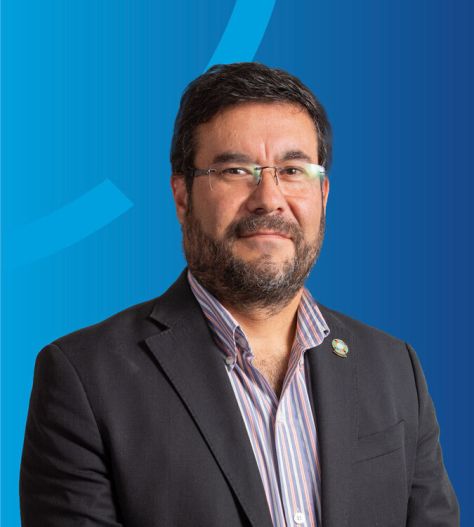
Dr. Hugo Navarrete has been a scholar, professor, and Director of Research, among other roles, at Pontificia Universidad Católica del Ecuador (PUCE). His efforts have focused on connecting civil society in general with academic activity, as well as disseminating the results of scientific research through the publication of informational material that is accessible for the general public. Furthermore, he has worked to strengthen ties with ministries and other governmental agencies to establish a fluent dialogue and mutual trust, which has allowed science to influence policy and public opinion. Navarrete’s research focuses on environmental contamination with heavy metals, biodiversity, and food safety. He is currently a researcher at PUCE and the Director of the Center for Applied Chemistry Studies (CESAQ-PUCE) at PUCE. With around 70 publications that have garnered more than 4000 academic citations, he is among the 100 most cited authors in Ecuador.
Additional Information
Program
Einaudi Center for International Studies
Latin American and Caribbean Studies
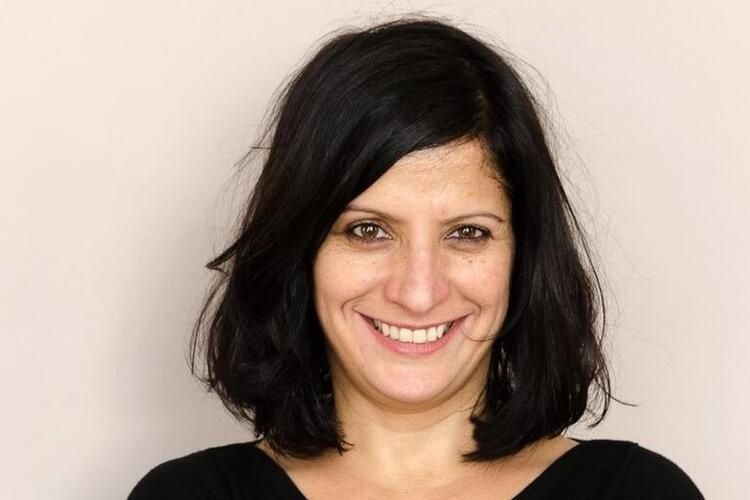
Samera Esmeir: Territorial Imperatives, Revolutionary Leanings: Thinking with the Palestinian Revolution
March 26, 2025
4:45 pm
Goldwin Smith Hall, Kaufmann Auditorium G22
Additional Information
Program
Einaudi Center for International Studies
Southwest Asia and North Africa Program
Information Session: Global Internships with Universidad San Francisco de Quito

October 28, 2024
1:00 pm
Go global in summer 2025! Global Internships give you valuable international work experience in fields spanning global development, climate and sustainability, international relations, communication, business, governance, and more.
This session will discuss opportunities with the Universidad San Francisco de Quito, a Cornell Global Hubs partner in Ecuador.
Register for this virtual session.
***
The Mario Einaudi Center for International Studies hosts info sessions for graduate and for undergraduate students to learn more about funding opportunities, international travel, research, and internships. View the full calendar of fall semester sessions.
Additional Information
Program
Einaudi Center for International Studies
Reppy Institute for Peace and Conflict Studies
East Asia Program
Southeast Asia Program
Latin American and Caribbean Studies
Institute for African Development
Institute for European Studies
Migrations Program