
Southeast Asia Program
Labor, Migration, and the Philippine Radical Tradition of Theatre
A reflection by SEAP faculty member Christine Balance, on a June 4th screening of Magno Rubio.
Dawn Bohulano Mabalon was a historian whose work centered on the lives, stories, and culture of manongs (older brothers or uncles) – migrant Filipino laborers who first arrived and settled in the U.S. at the turn of the 20th century. Manang Dawn, as she is lovingly known among her family and friends, was one of the first Filipinas to show me that a life of scholarly pursuit was possible. During the late 1990s, living in San Francisco, we would often work together at cafes and in her apartment – me studying for the GRE and preparing grad school applications while she read through the enormous binders of articles and notes she gathered for her PhD qualifying exams at Stanford University. From those days until her untimely passing in August 2018, Manang Dawn modeled for me ways of research, teaching, and community organizing steeped in a deep love and care for Filipino America.
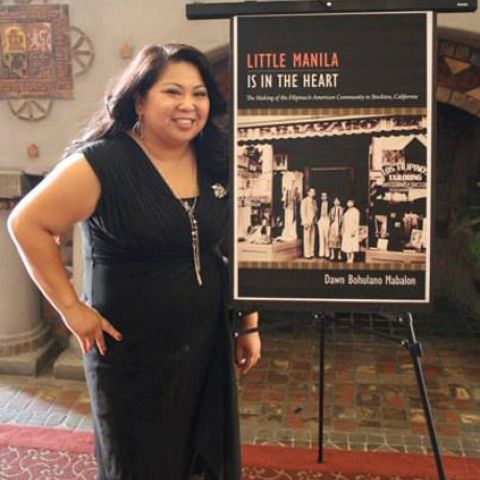
Dawn Bohulano Mabalon at Little Manila is in the Heart book launch and signing (July 2013, Stockton, CA)
Dawn was the daughter of an actual manong, Ernesto Mabalon, and the granddaughter of Pablo “Ambo” Mabalon, owner of the Lafayette Lunch Counter, a restaurant/diner opened in Stockton’s Little Manila in the 1930s. It was not until she was an undergraduate at UCLA, taking her first Pilipino Studies course with Royal “Uncle Roy” Morales and reading Carlos Bulosan’s canonical novel America is in the Heart, that she realized the historical significance of her lolo’s (grandfather’s) restaurant as well as her hometown.As Dawn wrote in the introduction to her Little Manila is in the Heart: the Making of the Filipina/o American Community in Stockton, California, when she asked her father about Bulosan after reading his novel, she learned that the famed Filipino writer used the Lafayette Lunch Counter as his permanent address and was gifted free meals by Lolo Ambo who “couldn’t bear to see Filipinas/os starve.” Skeptical of her father’s story, the intrepid young scholar researched Bulosan’s archive at the University of Washington, finding a letter from one of Bulosan’s girlfriends who mentioned sending correspondence via “Pablo” in Stockton. “Suddenly, my father’s memories became history, corroborated by archival evidence, and framed by my deeper understanding and embrace of my hometown’s Filipina/o American history.
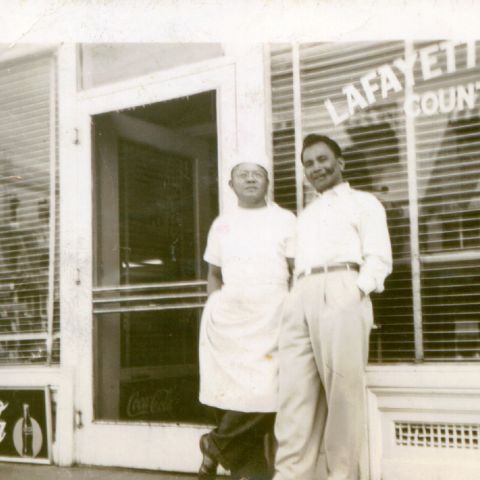
Right: Pablo 'Ambo' Mabalon (left), Dawn Mabalon's grandfather, stands in front of his Lafayette Lunch Counter, which was in the heart of Little Manila. (Courtesy Little Manila Rising)
In October 2008, Dawn worked to bring Bulosan back to Stockton’s Little Manila, helping to produce The Romance of Magno Rubio’s two benefit performances on behalf of the Little Manila Foundation, an organization she co-founded with Dillon Delvo in 1999 to save the area’s buildings and history. Based on a short story by Bulosan, The Romance of Magno Rubio recounts the pen pal courtship of Magno, an illiterate, immigrant farmworker, and Clarabelle, a white woman from Arkansas. The romantic correspondence is maintained by Nick, a more educated manong (and stand-in for Bulosan). While the promise and fantasy of the courtship is central to the plot, the play also stages the everyday experiences of these manongs – as immigrants, laborers, and young men.This past June 4, 2020, Lucy San Pablo Burns (UCLA) and I collaborated with the New York-based Ma-Yi Theatre Company to co-present a livestream screening of The Romance of Magno Rubio followed by a Q&A with actors Ron Domingo, Jojo Gonzalez, Ramon De Ocampo and dramaturge Professor Joi Barrios (UC Berkeley). Aiming to bring awareness to Ma-Yi Theatre’s work, the event kicked off SEAP’s 70th anniversary year and celebrated the inaugural Pilipino Studies minor at UCLA. At the heart of the event was our Manang Dawn – a UCLA alumna, a historian of Filipina/o farmworkers, and the daughter, niece, cousin, kumare (friend) raised by the manongs and manangs of California. Taking place amidst the events unfolding after George Floyd’s death, our live-streaming event and Q&A took on extra meaning as it underscored the dehumanizing effects of racism throughout America’s history while it also recalled the radical tradition of Philippine theatre and its making.
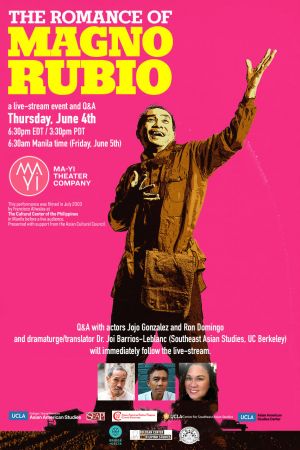
Flyer for June 4th The Romance of Magno Rubio live-streaming and post-screening Q&A
Its script composed of rhyming couplets, Magno Rubio centers Filipino performance forms and traditions – including the kundiman (romantic song), eskrima (Filipino martial arts), and balagtasan (verbal jousts) – as it tells a story of love and debt – love for a romantic other and for a home left behind, debt circumscribed by money and structuring sociality (i.e. utang ng loob or indebtedness to another person). In addition, as Joi Barrios points out, Magno Rubio “construct(s) characters reminiscent of the drama simboliko (symbolic drama)” – a theatre form that articulated the anti-colonial and anti-imperialist sentiments of the Filipino during the American occupation at the turn of the 20th century.” Here, we recognize the play’s “affirmation of the nationalist project in the Philippines.”When viewed within a longer Philippine radical tradition of theatre, including the early 20th century Philippine seditious plays produced under U.S. colonial rule, we also begin to see Magno’s relationship to Clarabelle as an allegory for the Philippines’ relationship to the U.S., one maintained by the promises and fantasies of reciprocity, futurity, indebtedness. By choosing to center Filipino theatrical traditions in this off-Broadway production, Ma-Yi envisioned a diverse audience that would recognize these performance forms, their histories and politics. At the same time, the show decolonized how Filipino stories, especially those in the diaspora, are told. By telling a Filipino story utilizing the techniques and styles of Filipino culture, Ma-Yi’s Magno Rubio works to undo any notions of a Filipina/o without a culture or history of her own.
Founded in 1989 by Chito Jao Garces, Ralph Peña, Margot Lloren, Ankie Frilles, Luz de Leon, Isolda Oca, Arianne Recto, Cristina Sison, and Bernie Villanueva, Ma-Yi Theatre Company also benefited, in its early days, from the involvement of Chris Millado as advisor to their first performance as well as playwright and director on future productions. An award-winning theatre organization that has developed new work by Asian American writers for the past 31 years, Ma-Yi is clearly grounded in the New York theatre scene. Yet, at the same time, it does not forget its founders’ earlier involvement with Peryante (formerly University of the Philippines’ Tropang Bodabil or UP Vaudeville Troupe) “a street theater group active from 1980-1987, a period of the Marcos dictatorship and Martial Law (1972-1986).” Thus, as Barrios writes in her introductory essay to Savage Stage: Plays by Ma-Yi Theater Company, “whatever the circumstances that prompted us to go to the U.S. … we brought with us to the site of migration Nicanor Tiongson’s definition of Philippine theater (“repleksyon ng pangangailangan ng nakaraming Pilipino” or “a reflection of the needs and aspirations of the greater majority of the Filipino people”) and the ideology of the ‘politicized artists’ of the Philippines.”
Armed with this ideology, Ma-Yi has expanded its scope, helping to develop and produce plays by, for, and about Asian Americans, while still maintaining the connections between U.S. and Philippines-based artists, actors, and playwrights. The version of Magno Rubio, which screened during the June 4th event, is a testament to such connections and transnational commitments. Filmed in July 2003 by New York-based filmmaker Francisco Aliwalas, this performance took place at the Cultural Center of the Philippines in Manila before a live audience and as part of the Sangandaan Festival. Peña and Ma-Yi decided to share the recorded production via live-stream from May 25 until June 4, during the early days of the Covid-19 pandemic’s shutdown of theatres. This digital turn was just the beginning for the company who has gone on to share other filmed performances and, most recently, developed its own Ma-Yi Studios, a broadcast studio for short films, live broadcasts of plays, readings, music performances, to name a few.
While Lucy and I did expect a good turn-out for this event – as it brought together faculty, staff, students, and community members from three Southeast Asian Studies-networked universities as well as four distinct geographical areas (New York/the Northeast, Southern California, Northern California/Bay Area, and the Philippines) – we were deeply moved by the deep artistic, political and personal attachments audience members had to the play. While we thought the story of Magno Rubio would resonate with Filipino immigrants and their children, the aesthetics of the show with scholars and students of Filipino arts and culture, what we did not anticipate were the ways in which the digital turn would greatly widen the audience for Ma-Yi Theatre’s important work. No longer impeded by air travel to New York City or Manila, more people across the country and the globe were able to experience firsthand this play’s artistry and storytelling. The ways in which this took shape are best reflected in the comments provided by audience members during the post-panel/Q&A discussion.
As Lily Ann Villaraza, professor and chair of the Philippine Studies department at City College of San Francisco, noted:
“(That’s) what really struck me about this piece – the lyricism and poetic structure of the narrative. It really did remind me of Philippine theatre and Philippine literature in general. The way that the audience was drawn in as another actor to the play too. It took my breath away. As much as the story is grounded here in the U.S., it felt very much like a theatre production you would see in the Philippines. But then again, I should not be surprised given the talent behind the story.”
Through the play’s bare staging and barbed wire perimeter – a design choice that creates a relationship and relationality between the audience and actors – Magno Rubio was able to draw audiences into the action and feeling of the play. Through the rhythm of speech and movement of the play itself as performed by the barkada (tight group) of actors, through the lilting of their voices and tempo of their conversations, we were drawn into the everyday lives of these young men, who are often only seen in photographs or in their present older age.
In spite of U.S. capitalism’s dehumanizing effects and the romance of community, the manongs of Magno Rubio are young, vibrant, and three-dimensional characters. We are drawn into their world: their disappointment with dreams deferred and exhaustion with America’s broken promises. We are drawn into their inter-group dramas and internal conflicts, into what Joi called their “makisama” or practices of being together (ones that Lucy pointed out as a particular “complex migrant homosociality”).
Another important segment of the audience that evening were the families of actual manongs. As Glenn Aquino reminded us that evening:
“I’m the son and grandson of Filipino farmworkers in central valley California and I think it’s important to remind folks that there are still Filipinos working in the agricultural fields of California and canneries in Alaska. I know this because many of them are my relatives and that this story is still as relevant as ever. Thank you for bringing this back.”
With this, we are reminded that the figure of the Filipino farmworker in America is not just one of the past but instead an integral part of today’s migrant/laborer struggle.
If we think of farmworkers as part of America’s present, then we must shift our understanding of the Filipino’s relationship to migration, agriculture, and labor as one not simply of the past, but also of the present. How might we, in turn, unite the Filipino farmworker’s struggle in the U.S. to that of farmworkers in the Philippines who are currently being killed at high rates, as Joi pointed out during the Q&A? How might we understand that the forms and practices of dehumanization that Magno Rubio underscores are not just relegated to a long-ago past but speak to our global present?
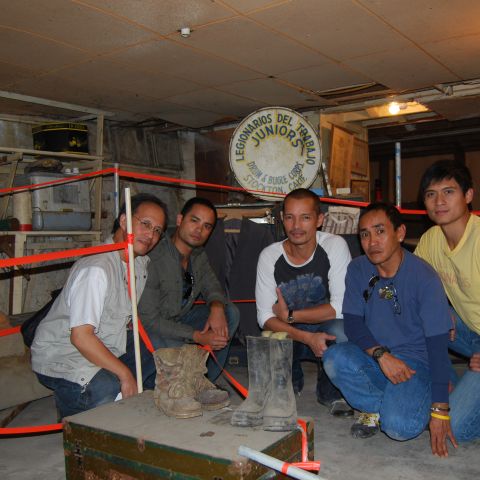
Magno Rubio cast members visit a recreated bunkhouse with materials found in manongs’ trunks in the Daguhoy Lodge of the Legionarios del Trabajo, one of the oldest Filipino American fraternal lodges in the U.S.
Finally, as an event organized by and featuring scholars from Cornell, UCLA, and UC Berkeley, the event’s audience was, as expected, composed of students from these campuses’ Filipino American studies, Asian American studies, and performing/media arts classes. With this in mind, the final question came from UC Berkeley student, Vince Marie Cuison, who asked the panelists if they had any advice for young, aspiring Filipino writers, artists, and performers. Vince’s questions were preceded by her heartfelt admission that our communal viewing of Magno Rubio, as a play & event that centered Filipino histories, culture, and artistic forms, deeply impacted her as a student and emerging artist.
As scholars, we often forget the impact that viewing high-caliber productions such as Magno Rubio can have on our students, especially those inclined toward the performing arts. To understand that one can draw from one’s own cultural and artistic traditions, to see the possibility of Filipino actors onstage and on-screen playing three-dimensional (i.e. not stereotypical) characters, to begin to imagine how to write and stage a world based upon one’s own history, and to do all of these things in an unapologetic and decolonized fashion. To do so is to work in the spirit and manner of our Manang Dawn Bohulano Mabalon.Rather than simply assimilating, in what ways can we as artists, scholars, students bring our cultures and histories to bear upon American institutions – be they of labor/farm work, American theatre, or even the university? What might this work especially mean for us, the children and grandchildren of former U.S. colonial subjects? How might we as the offspring of immigrants, or as immigrants ourselves, continue in the decolonial tradition – centering and valuing Filipino cultures, histories, organizations and their study?
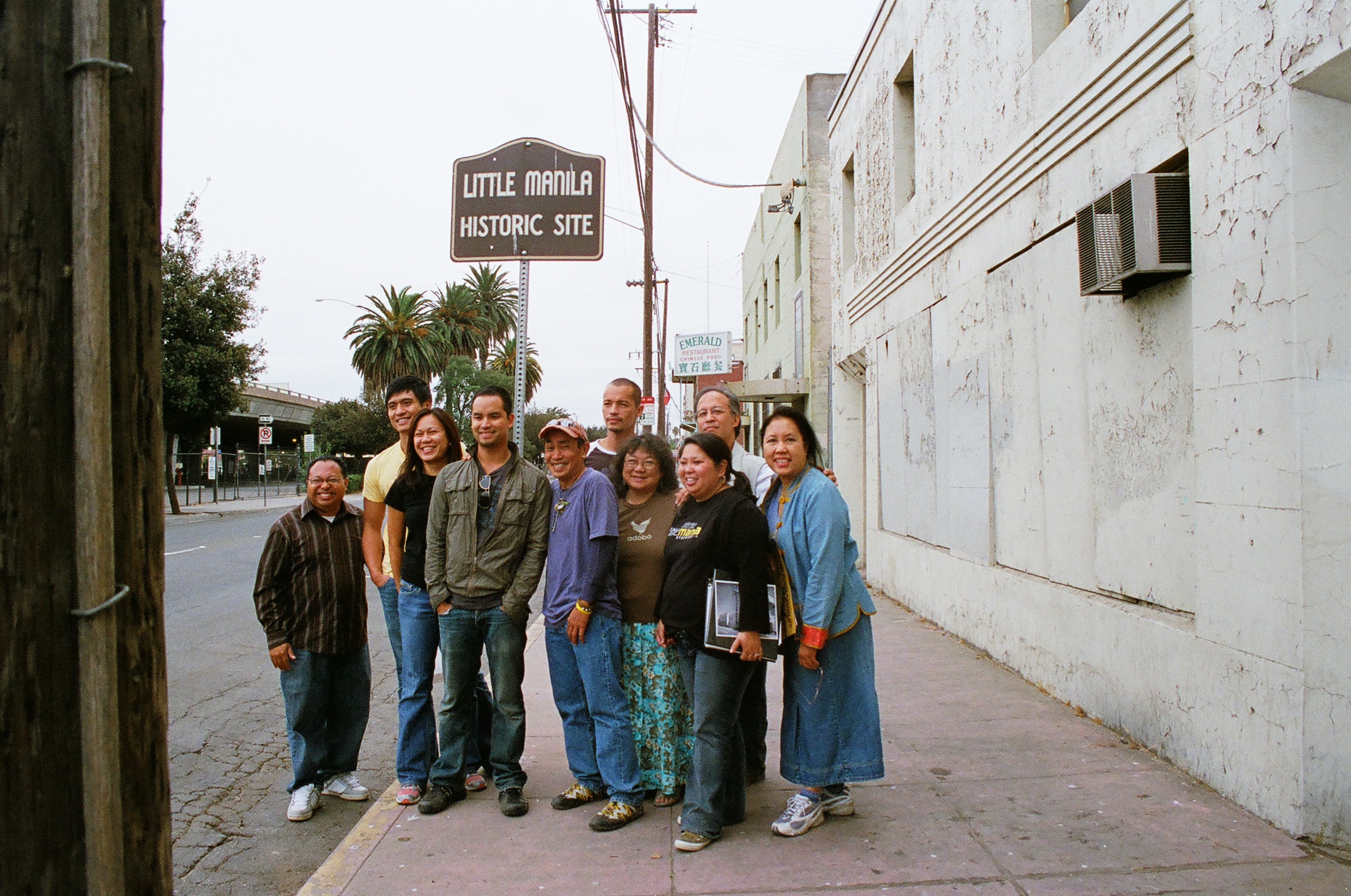
This is the work of Ma-Yi Theatre and its artists. This is the work of UCLA’s Pilipino Studies minor and the future of the Southeast Asia Program (SEAP) at Cornell. This is the work of students, scholars, and community members as we continue to advance Filipino studies, Filipino lives, and Filipino futures in the U.S., Philippines, and beyond.Magno Rubio cast members & Little Manila Board members (from left: Dillon Delvo, Paolo Montalban, Lailani Chan, Ramon de Ocampo, Jojo Gonzalez, Art Acuña, Jeannie Barroga, Dawn Bohulano Mabalon, Joseph Anthony Foronda, Elena Mangahas)
Additional Information
Program
SEAP Fall Gatty Lectures - Now Available on YouTube!
Recordings of several lectures from the Fall 2020 Gatty Lecture Series are now available on the Global Cornell YouTube channel!
Additional Information
SEASSI Applications Now Open!
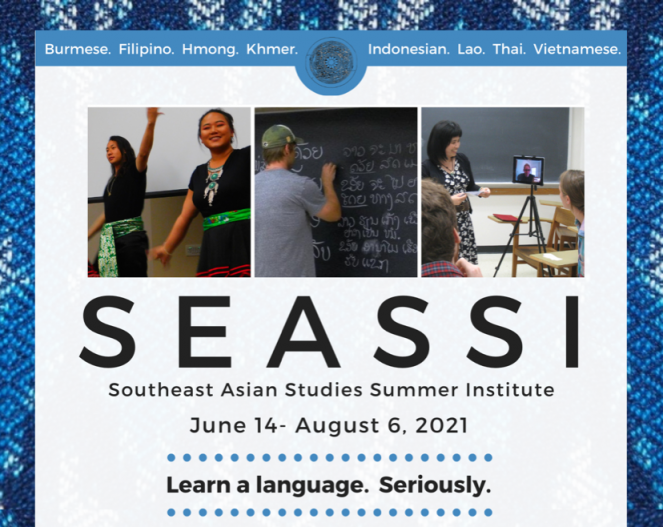
This summer’s SEASSI program will be held from June 14 through August 6, 2021. Applications for the 2021 SEASSI program are now available at seassi.wisc.edu!
Additional Information
Antiracist Pedagogy Workshop for Asian Studies
January 27, 2021
3:30 pm
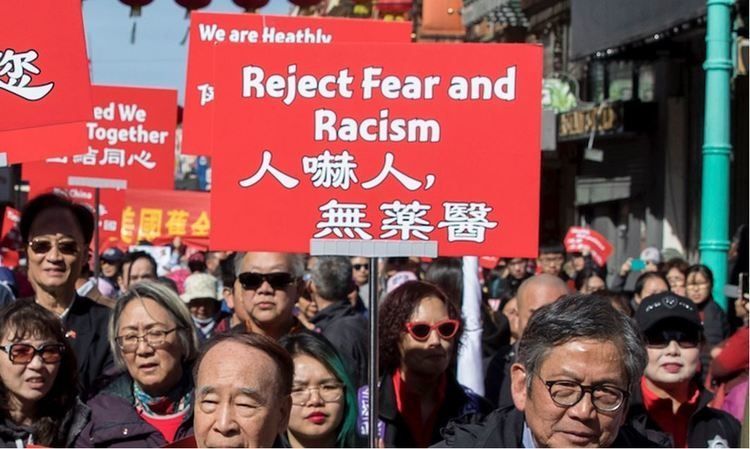
The workshop aims to offer an understanding of race, racism, and the particular racial formations embedded in the classroom and a discussion on ways to apply anti-racist pedagogy to courses in Asian studies. With scholars of Asian culture, history, and language participating, this workshop opens discussions on the challenges of incorporating anti-racist pedagogy into our classrooms to overcome both perceived personal and institutional barriers and on practical strategies and models of intentional anti-racist curriculum. The topics of discussion include teaching models of anti-racist and social justice, syllabus-making, selection of teaching materials, challenges and problems in the classroom, etc.
EAP Faculty host: Suyoung Son (Asian Studies)
Panelists include: Naoki Sakai (Asian Studies), TJ Hinrichs (History), Christine Balance (Performing & Media Arts), Ivanna Yi (Asian Studies), Stephanie Divo (Asian Studies), and Razima Chowdhury (Asian Studies)
Image by Getty Images
Additional Information
Program
Einaudi Center for International Studies
East Asia Program
Southeast Asia Program
South Asia Program
Cornell Modern Indonesia Project
Video introduction to the Cornell Modern Indonesia Project (2016), featuring Eric Tagliacozzo and Tom Pepinsky.
Additional Information
Program
Seed Grants

Details
The Einaudi Center's faculty seed grants launch international studies research and activities that show promise to grow and secure external follow-on funding.
Tenured and tenure-track Cornell faculty are eligible to apply. All disciplines and topics are welcome. Read about recent research Einaudi seeded.
Building International Studies Capacity
Einaudi Center seed grants support international studies research and collaborations that reach across world regions and bring together researchers who have deep knowledge in different regions and disciplines. The awards launch early-stage interdisciplinary research projects with clear plans for scaling up and securing external funding support.
The Einaudi Center is dedicated to international studies. Our seed grants focus on complex global and regional issues and community-engaged methodologies across the social sciences, hard sciences, and humanities. Some research conducted abroad and international collaborations—while valuable—do not qualify for the awards.
Proposals must align with the mission and interests of at least one of our international studies programs. The application requires only your own thoughtful assessment of how your project might contribute to the work of one or more programs.
Proposals that engage with two or more geographical regions are eligible for larger awards of up to $25,000.
Eligibility
Tenured and tenure-track Cornell faculty in all colleges and schools are eligible to apply as individuals or teams. The Einaudi Center will not accept proposals from past awardees who failed to submit the required final report by the deadline stated in the award letter.
- Funding-eligible activities: Data collection, research assistance, travel, meetings
- Not eligible for funding: Salary offset, summer salary, computers and equipment, student stipends/tuition
Requirements
- All funds must be used within one year of the award date.
- You must submit a final report to the Einaudi Center director within one year of the award date. The report must include:
- A summary and assessment of the research and activities you accomplished.
- An update on your external follow-on funding proposal.
- A promotional paragraph written for nonspecialists (100 words maximum) describing the outcome and value of your project.
- The Einaudi Center must be acknowledged in all publications, promotion, and media coverage related to your funded research and activities. Please inform the Einaudi Center in advance of publications and other project outcomes.
How to Apply
Complete the seed grant funding application and submit a proposal including the following:
- Curricula vitae (CVs) for principal faculty
- Statement including objectives, activities, work plan, expected outputs, beneficiaries, and impact
- Human subjects approval, if relevant
- Detailed budget with justification of expenses
- Plans for pursuing future research and external funding support
Evaluation
All successful proposals will meet these criteria. The proposal:
- Shows a high likelihood of generating new knowledge of key economic, environmental, social, cultural, or political problems in the world.
- Includes clearly articulated deliverables.
- Includes a budget appropriate for planned activities.
- Includes a plan for obtaining full project funding to sustain and expand the research.
Questions?
Please email our academic programming staff if you have questions about the seed grant program or your application.
Additional Information
Funding Type
- Award
Role
- Faculty
Program
SEAP Alum Taomo Zhou: Foreign Affairs Best Book 2020

Taomo Zhou, SEAP
Taomo Zhou’s Cornell University Press book, Migration in the Time of Revolution: China, Indonesia, and the Cold War, was recognized by Foreign Affairs as a Best Book of 2020!
Additional Information
6th Cornell Modern Indonesia Project Conference

The sixth CMIP conference, “Indonesian Languages and Linguistics: State of the Field,” was held in Jakarta, Indonesia, in February 2020.
The study of Indonesia has been an integral part of the Southeast Asia Program (SEAP) since its founding in 1954. That year, the Ford Foundation awarded SEAP a grant to build US scholarly expertise on Indonesia, and the Cornell Modern Indonesia Project (CMIP) was born.
Under the directorship of George Kahin and associate director John Echols, CMIP supported a wide range of studies on Indonesian politics and government in the rapidly changing context of the post-independence years. In later years CMIP expanded its focus to include Indonesian culture, history, and international relations, launching the journal Indonesia in 1966. The project also supported the translation of critical monographs and reports from Indonesian and Dutch into English. This collection is freely available on Hathi Trust.
In 2011 CMIP held the “State of Indonesian Studies Conference,” its first conference and an opportunity to revitalize the project in a new millennium. The conference brought eighteen scholars from around the world to Cornell to participate in six panel discussions on Indonesian anthropology, art history, history, language and literature, government and political science, and ethnomusicology. In the years that followed, SEAP faculty organized a series of conferences stemming from each of those six panels to explore Indonesian studies across a variety of disciplines.
Building on this legacy of scholarship, the sixth conference of CMIP entitled “Indonesian Languages and Linguistics: State of the Field” convened in Jakarta February 16-18, 2020. The conference was organized by SEAP Director Abby Cohn and co-hosted by Atma Jaya Catholic University, making this the first conference of CMIP to be held in Indonesia – a critical step to ensure extensive participation by Indonesian scholars, and harkening back to the roots of CMIP as a project to both develop scholarship on Indonesia and to expand access to such scholarship.
Additional Information
Program
Grounding Area Studies: Development Sociology in Southeast Asia

Development Sociology and the Study of Agrarian-Environmental Change in Southeast Asia, by Hilary Faxon, Nancy Peluso, and Peter Vandergeest
Students in development sociology (DSOC) view their approach to studying rural, agrarian, and environmental change as distinct; always starting on the ground or “in the field.” This approach evolved over the years in the department and clearly applied to DSOC students working in Southeast Asia after SEAP’s formation in 1950.
Most students arrive at Cornell for graduate studies having spent time in one or more countries of Southeast Asia. Some have been involved in development work through organizations like the Peace Corps or the Canadian volunteer organization Cuso International. Others choose Cornell because of the university’s strong reputation for research and political engagement in Southeast Asia as well as its broader profile in the region for research in history, politics, and anthropology.
Our intention in this article is to provide a sense of the ideas guiding Southeast Asia-based research of Cornell students and faculty in the Department of Rural Sociology, now the Department of Development Sociology. Further, we offer a few reflections on this community of practice and how it has changed over time.
SEAP’s founding in 1950 provided opportunities to deepen and extend work on rural transformation and development with attention to environments, communities, and agrarian change in Southeast Asia. Applied and theoretical research on these topics already had a long history at Cornell. READ MORE
Additional Information
Program
Race and Racism Across Borders

Writing and Visual Art by Einaudi Students
Einaudi students reflect on personal experiences of racism and border crossings. Don't miss this powerful conversation at Global Cornell.