
Southeast Asia Program
SEAP 70th Anniversary Virtual Exhibits
Be sure to check them out!
Over the course of the past year, members of the SEAP community have crafted two virtual exhibits exploring SEAP's history and celebrating its 70th anniversary. If you have not yet seen the exhibits, be sure to take a look!
(Re)collecting: SEAP 70th at the Museum
"(Re)collecting: SEAP 70th Anniversary at the Johnson Museum" uses the collections at the Johnson Museum to foreground the materialities and histories of individual objects and to connect these objects with broader flows of people, ideas, and things. These flows are what brought scholars to Cornell to study the region known today as Southeast Asia, and these flows also materialize the collection practices of individuals and institutions over time. As we investigate the biographies of objects and their collectors, we seek to discern patterns of power and procurement from this accumulation of rich stories; illuminate the efforts of individuals who may not yet be acknowledged in official, linear histories; and explore how objects in the collection continue to be used pedagogically by SEAP faculty today in ways that deeply influence the directions of current and future generations of scholars of Southeast Asia.
The full virtual exhibit is available here.
Building a Collection: Giok Po Oey and the John M. Echols Collection
Beginning with his hire in 1957 Giok Po Oey (1922-2010) worked tirelessly to build a world-class library collection of publications from and about Southeast Asia. His efforts, in collaboration with Cornell faculty, students and others interested in the region, resulted in what is widely recognized as the leading collection of its kind in the world. The foundation built during those formative years has created a legacy that has lasted far beyond Giok Po’s tenure as Curator when he retired in 1985, and now beyond his lifetime. This exhibit will follow the growth of the collection during the early years as Giok Po worked closely with the founders of Cornell’s Southeast Asia Program to build up this magnificent treasure known around the world as the John M. Echols Collection on Southeast Asia.
Additional Information
Program
GETSEA Mini Courses: Registration is now open!

Two free and virtual Fall 2021 courses
The consortium for Graduate Education and Training in Southeast Asian Studies (GETSEA) is offering two free and virtual mini-courses this fall, open to all graduate students studying Southeast Asia!
These courses do not offer credit, though students are encouraged to work with a faculty member at their own institution to count a course as independent study credit. Priority will be given to M.A. and PhD students from GETSEA member institutions but students from all institutions are welcome to apply. These courses entail a workload of equivalent to roughly one credit. Only those committed to completing all aspects of courses should apply. Applications are due September 20, 2021.
The Performing Arts in Southeast Asian History and Society
Taught by Supeena Insee Adler, Helen Rees, and Maureen Russell of the University of California, Los AngelesOffered virtually from October 18 to November 22, 2021, Mondays, 8:00pm-10:00pm EST
Scholar-Activism and the Myanmar Spring Revolution
Taught by Dr. Hilary Faxon, UC Berkeley and Dr. Tharaphi Than, Northern Illinois UniversityOffered virtually from October 20 to November 17, 2021, Wednesdays, 8:00pm-10:00pm EST
Additional Information
Program
Fall 2021 Southeast Asian Courses

Check out the great courses on offer for next semester!
From ancient history to modern film, regional politics to language studies, SEAP offers a variety of courses to suit many interests. In addition, you can choose from any of six Southeast Asian languages to study right here at Cornell.
Additional Information
Podcasts
Run by talented SEAP graduate students, the Gatty Rewind Podcast features interviews and conversations with scholars and researchers working in and around Southeast Asia, all of whom have been invited to give a Gatty Lecture at SEAP. For more information on the Gatty Lecture series and to view our upcoming lectures, click here.
An Enduring Legacy: The Beginning and Development of the Frank H. Golay Memorial Lecture Series

By James Nagy, SEAP Administrative Assistant
As featured in the Spring 2021 SEAP Bulletin, this article explores the life of SEAP's infamous Frank H. Golay Memorial Lecture Series. Through this lecture series, the SEAP community has had the honor of hearing many acclaimed scholars speak about their work in the field of Southeast Asian Studies.
When Frank H. Golay passed in late summer 1990, it was scarcely a week before donations started arriving at the SEAP office from colleagues, former students, and friends; all were seeking a way honor the late professor and former SEAP Director. Within two years, over forty individuals had contributed to a memorial fund set up in Golay’s name. In consultation with his widow Clara and the SEAP faculty, it was decided during the 1992-93 academic year that a memorial lecture series would be established to “examine the prospects facing Southeast Asian studies” and to call “attention to innovative lines of research for demonstrating the integrity and value of Southeast Asian studies”[i]
Trained as an economist, Frank H. Golay not only became a respected Filipinist, but also a strong proponent of interdisciplinary approaches to the developing area studies field of Southeast Asia. Beyond his academic work, Frank H. Golay played a significant part in the establishment of SEAP, being one of its Directors (1970-76), head of the Philippine Project (1967-73), and head of the London-Cornell Project (1968-70). Indeed, his actions during his directorship largely enabled SEAP to remain financially stable and even prosper throughout the ensuing decades, even as funds elsewhere dwindled.
Recalling Golay’s contributions to the academic culture and vitality of the Program, the first three speakers of the newly established Frank H. Golay Memorial Lecture were not chosen haphazardly. Rather, there was a sense that the choice of the inaugural speakers and the associated topics and themes would set the tone not only for the series, but also for the future of SEAP and even the field of Southeast Asian studies more broadly, which faced uncertainty and instability in light of changing disciplinary interests, among other pressures, after the Cold War.
Economist Erik Thorbecke, a SEAP faculty member, was chosen to be the inaugural lecturer in order to highlight possible new avenues of research in the field of Southeast Asian Studies and address the field from within. In 1996, Oliver Wolters remarked to then-Director Randy Barker the hope that Thorbecke’s lecture would suggest “what the future could mean for the Program when the Program responds to those who are urging it to extend the range of its academic concerns.”[ii] As Thorbecke represented both the humanities and the social sciences in a vein similar to Golay himself, Thorbecke was chosen in order to highlight the fundamental link between these different and often competing disciplinary interests in area studies.
Erik Thorbecke’s inaugural lecture,[iii] “The Political Economy of Development: Indonesia and the Philippines,” was not merely a comparative study between these two Southeast Asian nations, but rather sought to synthesize theory and data in both the humanities as well as the social sciences in order to pose new questions about how these fields might work together in the advancement of Southeast Asian Studies. READ MORE
[i] SEAP internal memo from Oliver Wolters to SEAP Director John Wolff concerning the Golay lecture series’ inclusion in the Program’s NRC proposal, pg. 2 (October 8, 1996).
[ii] SEAP internal memo from Oliver Wolters to SEAP Director Randy Barker, p. 1 (October 25, 1993). Many of these same thoughts can be seen in Wolter’s 1994 article “Southeast Asia as a Southeast Asian Field of Study” (Indonesia 58, October 1994).
[iii] Later published under the same title by SEAP Publications.
Additional Information
Program
Lao Offered at NIU!
Academic Year Lao Language Instruction to be offered via synchronous distance learning at NIU
Full-time students should apply for tuition support now!
Northern Illinois University CSEAS and Cornell SEAP have joined forces to offer Lao language instruction online, via synchronous video class, during the 2021-22 academic year. The NIU course to be offered will be either beginning or intermediate, depending on student demand. All interested individuals are encouraged to inform SEALC (SEALC@intl.wisc.edu) so that we can track demand and advocate for funding to continue and expand this exciting pilot.
Scholarship eligibility:
Any full-time student at a North American college or university is eligible to apply for the SEALC-GETSEA tuition support that will cover a significant portion of the cost of the course: https://sealc.wisc.edu/for-students/ The deadline for applying for tuition support is July 15, 2021—so apply now if you are interested.
Questions can be sent to sealc@intl.wisc.edu or getsea@cornell.edu. The NIU enrollment links will be sent when they become available.
Additional Information
Program
Previous Conferences
27th Cornell SEAP Graduate Student Conference
March 7-9, 2025
Chair: Alena Xinyue Zhang
The 27th annual Graduate Student Conference was held March 7-9, 2025 at the George McT. Kahin Center for Advanced Research on Southeast Asia. Under the theme of Mobility, this year's conference reflected on mobility and its constraints. We set out to explore that which is trans (-national, -Pacific, -imperial, -gressive) or in trans (-ition, -mission, -lation).
Competence and Control: The Effect of Democratization on the Civil Service

June 24, 2021
10:00 am
Join the Southeast Asia Program (SEAP) and the Sydney Southeast Asia Centre for our upcoming IS4 webinar exploring the effect of democratization on Indonesia's civil service.
Does democratization lead to more meritocracy in the civil service? In this webinar, Associate Professor Jan Pierskalla argues that electoral accountability increases the value of competence over personal loyalty in the civil service. While this resembles an application of merit principles, it does not lead to an automatic reduction in patronage politics. In the context of elections in low-income countries, competent civil servants are used to facilitate the distribution of clientelistic goods at mass-scale to win competitive elections. The selection of competent but less loyal civil servants also requires the increased use of control mechanisms, like the timing of promotions, to ensure compliance by civil servants. Associate Professor Jan Pierskalla tests these claims using novel micro-level data on promotions in Indonesia's civil service before and after democratization in 1999.
We warmly invite you to join Associate Professor Jan Pierskalla, Ohio State University, in conversation with Professor Tom Pepinsky, Cornell University to explore the effect of democratization on Indonesia's civil service. The conversation will be moderated by Assistant Professor Jessica Soedirgo from the University of Amsterdam.
Additional Information
Program
Einaudi Center for International Studies
Southeast Asia Program
Bridging Worlds, Connecting Communities: A History of SEAP Outreach, the Early Years
by Brenna Fitzgerald, SEAP Communications and Outreach Coordinator
As featured in the Spring 2021 SEAP Bulletin, this article recounts the early years of SEAP Outreach with its mission to share Southeast Asian culture with local educators and the community at large, beginning in the 1970s.
The idea of outreach for SEAP—before it was defined as such and turned into a formal office in 1977—was initially intended to address the dissemination of knowledge about countries, cultures, and languages of Southeast Asia. In the early 1970s, faculty appeared at national conferences, on TV and radio, and at local community colleges. They served as business and cultural advisors, especially on politics and economics in Southeast Asia. In these early years, the John [BEF1] M. Echols Collection on Southeast Asia—one of the largest of its kind—became available to the non-Cornell community, including local junior and senior high school and community college educators and students.
SEAP has received Title VI funding every year from the US Department of Education in the form of a National Resource Center (NRC) grant since 1960. For the first ten years of its growth, these funds were mostly allocated to building language and course offerings, in an effort to train scholars, and also to growing library acquisitions, quickly establishing SEAP at Cornell as one of the top Southeast Asia area studies programs in the country. Outreach, now carried out with significant Title VI funding, was not mentioned in any of the early grants until the 1970s, when the Department of Education began to ramp up the importance of relationships with the community in NRC grant priorities.
Indeed, in the early 1970s, as the Vietnam War raged on and as Southeast Asia became front and center in the national and international consciousness, SEAP received increasing requests from various communities for knowledge about the cultures and countries of Southeast Asia. These requests came primarily from the US government, other universities and local community colleges, K-12 schools, and a range of organizations in the upstate New York Finger Lakes region, which was increasingly becoming home to many refugees from Vietnam, Cambodia, and Laos.
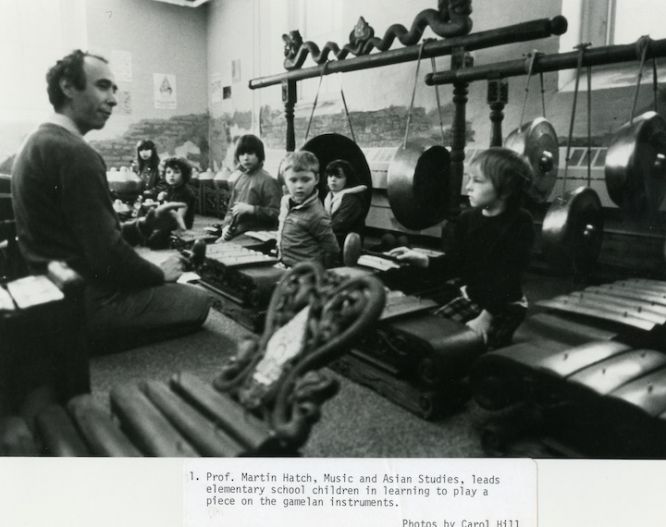
In 1973, Cornell opened the Herbert F. Johnson Museum of Art, which soon became a major resource for the public as well as a vehicle for SEAP to share Southeast Asian culture with a wider audience. SEAP faculty collaborated with the [BEF2] museum to offer talks and curated exhibitions open to the public. Around this same time, Harrison Parker, a Cornellian working in Indonesia for the State Department, brought back enough musical instruments to form two gamelan ensembles at Cornell after his time working at the embassy. The first official gamelan was set up in Risley Hall, and SEAP used gamelan performances on campus as a vehicle to get people interested in and engaging with Southeast Asia.
According to Martin F. Hatch, professor emeritus, who received his PhD in music from Cornell in 1971 and eventually took over as director of the Cornell Gamelan Ensemble in 1980, “outreach plays a role in keeping people engaged and brings out the strengths and vitality of a place.” He noted that gamelan became the perfect outreach tool early on, because this performance art is “immediately accessible and more directly tied to Southeast Asian ‘practice’—namely, to what (some) Southeast Asians actually DO, and what many ‘LIKE’ . . . It isn’t mediated through the mind of someone else—the words/works of an authority on the subject . . . and delivers something much closer to the Southeast Asian experience, to Southeast Asian culture in practice.”[i]
In the early 1970s, while Marty was intimately involved in building the Cornell Gamelan Ensemble and coordinating performances all over New York State, outreach became more than just simply disseminating knowledge. In tandem with new Department of Education priorities, SEAP shifted focus to community impact through sustained engagement and recognized the need for a staff member fully devoted to this mission.
The first SEAP outreach coordinator, Dr. William J. O’Mally (Bill), appointed to the newly created position in February of 1977, was a fellow graduate student with Marty. Bill received his PhD in Southeast Asian history and government, working under Professor George Kahin, and was familiar with SEAP’s resources and policies. From the time of his appointment until June 1977, Bill concentrated his efforts on planning and developing a comprehensive program of outreach activities in consultation with instructors at nearby institutions and SEAP faculty. Target audiences for outreach collaborations included local high schools, regional colleges and universities, and the community at large. READ MORE
[i] Martin F. Hatch, Zoom interview by author, December 9, 2020.
Additional Information
Program
GETSEA Mini-Course CFP

Deadline extended to June 18!
The deadline to propose a GETSEA mini-course has been extended to June 18, 2021!
Click here for more information about GETSEA mini-courses and to view the call for proposals.
Interested faculty at GETSEA institutions are invited to craft mini-course proposals, keeping in mind that these courses are virtual and open to graduate students from all GETSEA institutions – and graduate students in Southeast Asian studies further afield if space allows.
For examples of current and previous GETSEA mini-courses, click here.