
Einaudi Center for International Studies
Hype Springs Eternal: AI, Memory, and War
November 12, 2026
12:00 pm
Uris Hall, G08
In 1958, the Office of Naval Research unveiled the Perceptron, the first neural network for artificial intelligence, created by Cornell psychologist Frank Rosenblatt. The Navy expected it to read and write within a year. Nearly seventy years later, the Pentagon is again betting on AI to revolutionize war, while industry leaders promise that recursive self-improvement and superintelligence are just around the corner. Why does the military accept exceptional expectations about AI despite repeated disappointment? Part of the answer is rethinking technology hype. Because we cannot fact-check the future, hype is better understood as performative discourse than as exaggeration. This expectant, dramatic, and imminent discourse can be studied in real time, regardless of whether it proves true. Part of the answer is remembering forgetfulness. Learning supposedly tempers expectations, but forgetting can reset them. I trace AI hype from Dartmouth and DARPA through the Lighthill Report, Strategic Computing, and the Third Offset. I show that hype runs on both hope and fear, and that the exceptional expectations it evokes cycle as technical performance and forgetting interact.
About the speaker
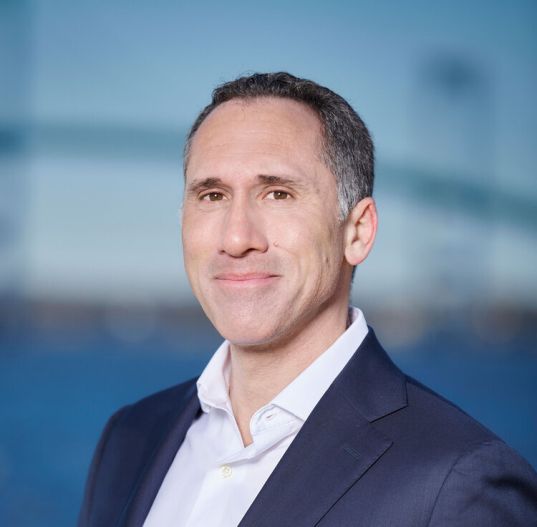
Frank L. Smith III is the director of the Cyber and Innovation Policy Institute (CIPI), part of the Strategic and Operational Research Department in the Center for Naval Warfare Studies at the U.S. Naval War College. Smith was previously a senior lecturer in the Department of Government and International Relations at the University of Sydney. His interdisciplinary research examines the relationship between emerging technology and national security, particularly in cyberspace. He has a Ph.D. in political science and a B.S. in biological chemistry, both from the University of Chicago.
Host
Reppy Institute for Peace and Conflict Studies, part of the Einaudi Center for International Studies
Additional Information
Program
Einaudi Center for International Studies
Reppy Institute for Peace and Conflict Studies
Power Without Hierarchy: Relational Geopolitics, Total Defense, and International Order

November 5, 2026
12:00 pm
Uris Hall, G08
How can political actors generate geopolitical power, deterrence, and resilience without concentrating authority in a sovereign hierarchy? Dominant approaches in international relations tend to locate strategic capacity in actors and their material resources, treating relations primarily as channels for cooperation, competition, or influence. This lecture advances a theory of relational geopolitics in which strategic capacity is generated through relationships themselves. In the process, relations reshape actors’ interests, identities, resources, and ability to act. The theory proposes four mechanisms connecting relational configurations to geopolitical outcomes: resource aggregation, institutional conversion, reciprocal commitments, and relational redundancy. These mechanisms can also operate in reverse when collective action fails. I develop the argument through the European Union’s emerging strategy of total defence. Across military preparedness, economic security, infrastructure, enlargement, societal resilience, and external partnerships, the EU is designing strategic effects through a system of institutions, collective identities and relationships rather than through centralized command. The lecture concludes by outlining a comparative research agenda for studying relational power, deterrence, resilience, and breakdown across alliances, regional organizations, non-Western regional formations, and contested international orders.
About the speaker
Dr. Veronica Anghel works at the intersection of comparative politics and international relations. As an assistant professor at the Robert Schuman Centre for Advanced Studies she co-directs the European Governance and Politics Programme and leads the ‘Global Risks to the EU’ project. Her current research focuses on the European Union’s geopolitical role in the global order, and European integration and enlargement. She is also a Visiting Professor at the College of Europe and an Associate Editor for the Journal of European Public Policy. She has been awarded the Inaugural ‘Rising Star’ Award of the European Consortium for Political Research (ECPR) in 2021.
Host
Reppy Institute for Peace and Conflict Studies, part of the Einaudi Center for International Studies
Additional Information
Program
Einaudi Center for International Studies
Reppy Institute for Peace and Conflict Studies
Institute for European Studies
China's Nuclear Arguments: Building a Domestic Consensus for Arsenal Modernization

October 29, 2026
12:00 pm
Uris Hall, G08
Around 2019 signs first emerged that China had embarked on its most significant nuclear modernization program since it became a nuclear power in 1964, but Western scholars disagree on China’s motivations for doing so. This paper offers a framework to explain major changes in China’s nuclear policy that highlights the role of domestic politics in those choices. I argue that China’s recent nuclear modernization required the formation of a consensus among domestic actors who influenced nuclear decision making. Each of these actors supported the modernization for different reasons. Relying on the first interviews with experts in China since the COVID-19 pandemic as well as original Chinese-language documents, the paper identifies four motivations for the modernization: China’s arsenal survivability, the political leverage that a larger arsenal can provide, avoiding perceived mistakes of Soviet nuclear policy, and influencing conventional war outcomes. It identifies proponents for each of these arguments among key groups involved in China’s nuclear decision-making: nuclear laboratories and experts, national security generalists who lack specialist nuclear expertise, the top leader, and the missile force. This domestic political lens also helps to explain the lack of change in China’s nuclear policy in the past.
About the speaker
Fiona Cunningham is Assistant Professor of Political Science at the University of Pennsylvania. Her research interests lie at the intersection of technology and international security, with a focus on China. Fiona’s first book, Under the Nuclear Shadow: China’s Information-Age Weapons in International Security (Princeton University Press, 2025) won the Peter Katzenstein Book Prize and Edgar S. Furniss Book Award. The book examines China’s distinctive approach to the dilemma of coercing an adversary under the shadow of nuclear war, which relies on information-age weapons (offensive cyber operations, counterspace capabilities and precision conventional missiles) as substitutes for nuclear threats. Her articles on nuclear strategy, cybersecurity, escalation dynamics, international law, and U.S.-China relations have appeared in International Security, Security Studies, Journal of Strategic Studies, and Texas National Security Review. Fiona has held fellowships at the Renmin University of China in Beijing, Harvard University, Stanford University, the Carnegie Endowment for International Peace, and Yale University. She has nonresident affiliations with the MIT Security Studies Program, the Carnegie Endowment for International Peace, and the ANU National Security College. She received her PhD in political science from MIT.
Host
Reppy Institute for Peace and Conflict Studies, part of the Einaudi Center for International Studies
Additional Information
Program
Einaudi Center for International Studies
Reppy Institute for Peace and Conflict Studies
The Predatory Sea: Human Trafficking and Colonization in the Seventeenth-Century Caribbean

October 1, 2026
12:00 pm
Uris Hall, G08
The Predatory Sea: Human Trafficking and Captivity in the Seventeenth-Century Caribbean (University of Pennsylvania Press, 2025)
Colonialism is often imagined as an imperial project organized by officials at the highest levels of the state. For the earliest English and French colonies in the Caribbean, nothing could be further from the truth. Between 1570 and 1670, a multinational assortment of privately funded ship captains, sailors, merchants, and adventurers engaged in widespread practices of captive-taking and human trafficking throughout the Caribbean. Raids against coastal communities and regional shipping in the region ensnared multitudes, including free and previously enslaved people of African and Indigenous descent, who found themselves trafficked into slavery away from their communities of belonging. Beginning in the 1570s, their captors established maritime bases on small, strategically located islands throughout the region. Those anchorages served as temporary settlements for northern European traffickers decades before their respective monarchs sanctioned official colonies. Colonization thus started with practices of captive-taking and human trafficking, which remained central to the development of the first English and French colonies in the Caribbean.
Through extensive research in Spanish, French, and English archives in Europe and the Caribbean, The Predatory Sea offers a fresh perspective on how captivity and maritime violence shaped early English, French, and Dutch settlement. Drawn from sources across imperial archives, the book reveals the experiences of those ensnared in this trade. Many captives escaped to Spanish population centers, where they testified to officials about what they witnessed in early English, French, and Dutch colonies. Those testimonies informed a series of Spanish attacks on foreign settlements in the Caribbean over the decades leading up to the 1650s. Captives were cause and consequence of inter-imperial competition and warfare during this violent century of Caribbean history. This captive economy, as explicated in The Predatory Sea, shaped English and French colonization, inter-imperial competition, and the lived experiences of captives and their captors.
About the speaker
Casey Schmitt is an Associate Professor of History at Cornell University where she researches and teaches on early modern colonization, mobility, empires, and slavery. Her work has appeared in the Hispanic American Historical Review, Early American Studies, and the William & Mary Quarterly and she has received support from the National Endowment for the Humanities, the American Council of Learned Societies, the American Historical Association, and the Cornell Center for Social Sciences among others.
Host
Reppy Institute for Peace and Conflict Studies, part of the Einaudi Center for International Studies
Additional Information
Program
Einaudi Center for International Studies
Reppy Institute for Peace and Conflict Studies
Latin American and Caribbean Studies
Private Military Companies (PMCs) and Peacekeeping

September 24, 2026
12:00 pm
Uris Hall, G08
In the late 1990s, a new private military company (PMC) from South Africa, Executive Outcomes, intervened in Angola and Sierra Leone, where the company's operations ushered in a ceasefire. Still, when Executive Outcome's CEO, Eeben Barlow, declared his PMC capable of doing "what blue helmets could not," few in the peacekeeping and NGO world took him seriously. Twenty years later, after the rise of the Russian PMC Wagner Group, peacekeeping and mercenaries are direct competitors. Countries who traditionally contributed soldiers to the UN, such as Rwanda, Uganda, and Burundi, now market their troops to Exxon and the Gaza Board of Peace. Whether UN peacekeeping can survive this latest round in the privatization of warfare remains to be seen.
About the speaker
John Lechner graduated from the Master of Science in Foreign Service (MSFS) Program at Georgetown University’s School of Foreign Service. At Georgetown, John focused on security issues in Central Africa and the Sahel; Turkey; Russia, and the former Soviet Union. He is an expert on Russia’s growing influence in Africa. He speaks fluent Russian; advanced French, Turkish, and Georgian; and conversational Bosnian-Croatian-Serbian (BCS), Chechen, German, and Sango (the lingua franca of the Central African Republic).
After working in finance for several years, John decided to leverage his language skills and significant experience living abroad—especially in Russia and Europe—for a career in international affairs. After arriving in Washington DC, he took an internship with the Foundation for Defense of Democracies (FDD), analyzing and publishing articles on Turkish domestic politics, security, and foreign relations.
While attending Georgetown he has continued to work as a freelance journalist, covering issues related to language, history, culture, and politics in eastern Ukraine, Moldova, Turkey, the Sahel, and the Central African Republic. He is an expert on the history, languages, and politics of Central Africa, Turkey, and the former Soviet Union. You can find his articles published in Foreign Policy, War on the Rocks, Kyiv Post, The Diplomat, Africa is a Country, African Arguments, The National Interest, and Defense One, among others.
His book Death Is Our Business: Russian Mercenaries and the New Era of Private Warfare was published by Bloomsbury in 2025.
Host
Reppy Institute for Peace and Conflict Studies, part of the Einaudi Center for International Studies
Co-sponsor
Institute for European Studies, part of the Einaudi Center for International Studies
Additional Information
Program
Einaudi Center for International Studies
Reppy Institute for Peace and Conflict Studies
Institute for European Studies
Institute for African Development
Breakdown and Reconfiguration: SEAP Graduate Student Conference
October 24, 2026
12:00 am
Kahin Center
The 29th SEAP Graduate Student Conference will be held on October 23-24, 2026 at Cornell University’s Kahin Center for Advanced Research on Southeast Asia in Ithaca, New York, and on Zoom.
Please direct any questions to seapconference29@gmail.com.
Additional Information
Program
Einaudi Center for International Studies
Southeast Asia Program
Sea-ing Indonesia: Artists in Dialogue & Workshop
September 26, 2026
12:00 pm
Johnson Museum of Art, Robinson Lecture Hall, Floor 2L
Part of the two-day symposium Sea-ing Indonesia
Citra Sasmita, Artist, and Wayan Kun Adnyana, Artist & Rector of the Indonesian Institute of the Arts (ISI) will discuss there work and how it addresses issues of gender, activism and the environment on the island of Bali, Indonesia. After brief introductions, their 20-minute talks will be followed by a dialogue and Q&A moderated by Kaja McGowan.
A drawing and puppet-making workshop with upcycled materials will be held by the artists following the talk, from 2pm to 4pm. Anyone interested in joining the workshop should contact Kaja McGowan (kmm22@cornell.edu).
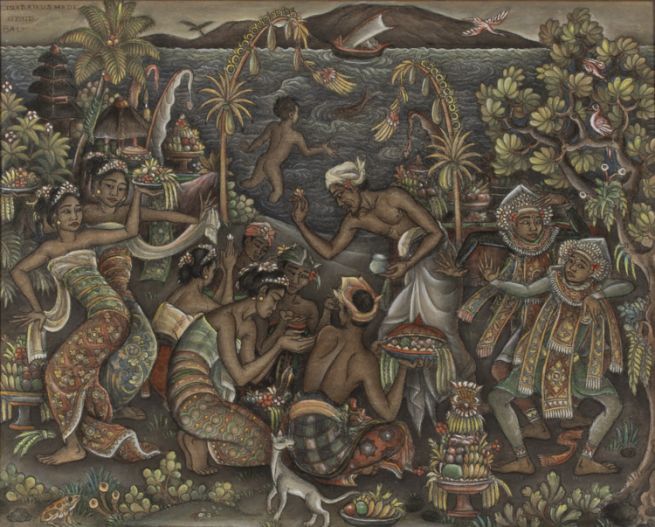
Photo:
Ida Bagus Madé Poleng
Indonesian, 1915–1999
Ceremony by the Sea, ca. 1968
Tempera on canvas
Collection of the Herbert F. Johnson Museum of Art, Cornell University
Acquired through the George and Mary Rockwell Fund; 2018.061
Image courtesy of the Johnson Museum
Additional Information
Program
Einaudi Center for International Studies
Southeast Asia Program
‘Pompeii: Out of Time’ Reveals Surprising Survival Stories

Caitlín Barrett, Einaudi Faculty Associate
Caitlín Barrett, a Cornell University archaeologist, contributes to new research and a docuseries focusing on the daily lives and survival of residents in ancient Pompeii.
Additional Information
Cornell Winter Program in Cambodia Info Session
September 16, 2026
12:15 pm
Rockefeller Hall, 374 (Asian Studies Lounge)
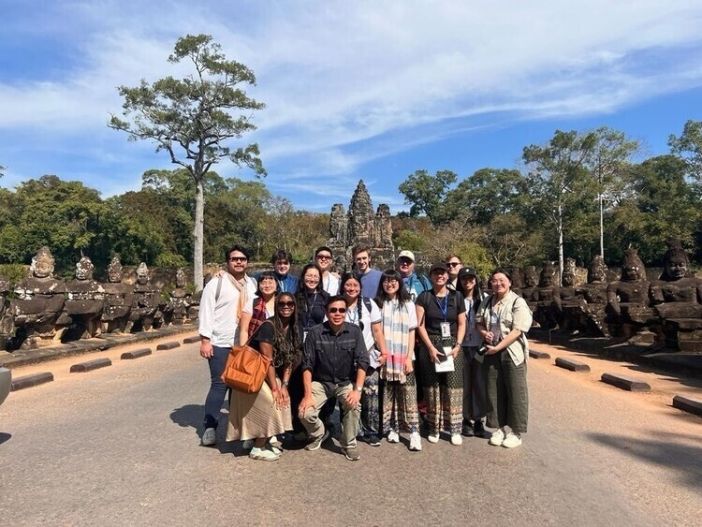
Come learn more about our winter study abroad in Cambodia, lunch provided. In collaboration with the Center for Khmer Studies (CKS), Cornell's Southeast Asia (SEAP, Einaudi) Study Abroad program in Cambodia will provide an in-depth focus on the cultural heritage of Cambodia both past and present. This highly interactive course will focus on Cambodian heritage past and present — how it's been created in the past, including the city of Angkor, and how that heritage and history is understood and engaged today. We will visit historical sites as well as museums and other relevant sites, including performances, where history is remembered and engaged.
Additional Information
Program
Einaudi Center for International Studies
Southeast Asia Program
Cornell Winter Program in Cambodia Info Session

September 1, 2026
4:45 pm
Rockefeller Hall, 374 (Asian Studies Lounge)
Come learn more about our winter study abroad in Cambodia. In collaboration with the Center for Khmer Studies (CKS), Cornell's Southeast Asia (SEAP, Einaudi) Study Abroad program in Cambodia will provide an in-depth focus on the cultural heritage of Cambodia both past and present. This highly interactive course will focus on Cambodian heritage past and present — how it's been created in the past, including the city of Angkor, and how that heritage and history is understood and engaged today. We will visit historical sites as well as museums and other relevant sites, including performances, where history is remembered and engaged.
Additional Information
Program
Einaudi Center for International Studies
Southeast Asia Program