
Institute for European Studies
Info Session: European Studies Minor and Undergraduate Funding Opportunities

September 8, 2022
4:45 pm
Through an interdisciplinary curriculum that you can mold to your interests, the European studies minor provides the opportunity to explore Europe’s past, present, and future.
You will cultivate a knowledge of European languages, culture, history, politics, and international relations. The minor offers the chance to take courses across colleges on subjects that shape your understanding of a globalizing world, while also providing you with an area of expertise. You will gain critical thinking skills, language abilities, and helpful frameworks for assessing today’s most pressing issues in Europe and around the world.
Several funding opportunities are available for you to pursue undergraduate research projects focused on Europe. Join this Einaudi Center Student Info Session to learn about application requirements, deadlines, and how to construct a strong proposal.
Additional Information
Program
Einaudi Center for International Studies
Reppy Institute for Peace and Conflict Studies
Institute for European Studies
Dissidence: Exiled Writers on Resistance and Risk
September 23, 2022
12:00 pm
Goldwin Smith Hall, G64
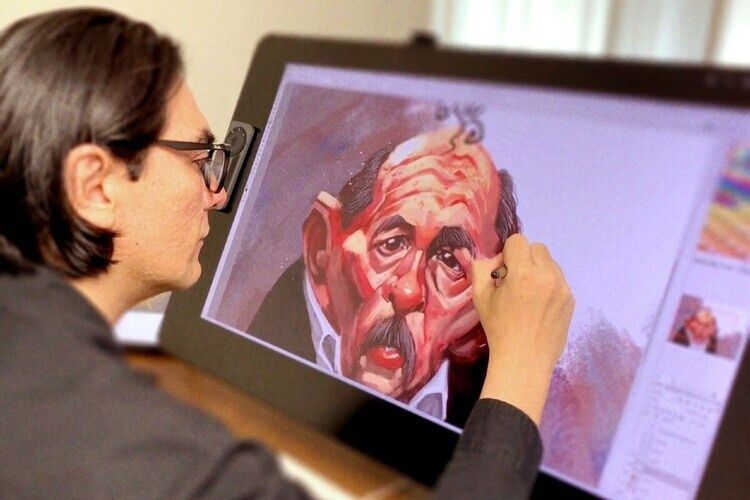
Poet Dmitry Bykov was nearly killed in a poisoning, then found himself banned from teaching at Russian universities. Essayist Pwaangulongii Dauod received death threats for writing about queer culture in his native Nigeria. Cartoonist Pedro X. Molina watched as Nicaraguan state forces jailed his colleagues and occupied the offices of the newspaper where he published his work. Novelist Anouar Rahmani was threatened with imprisonment for writing about human and environmental rights in Algeria.
All four were forced to flee their homelands, and all four were able to resume their creative work in “cities of asylum” in the United States.
“DISSIDENCE: Exiled Writers on Resistance and Risk” is supported by a grant from Cornell University’s Migrations Global Grand Challenge and the Mellon Foundation’s Just Futures Initiative. The event is also supported by CIVIC. The Migrations Initiative, part of Global Cornell, studies the movement of all living things through an interdisciplinary, multispecies lens, with a special focus on themes of racism, dispossession, and migration.
About the writers
Dmitry Bykov (Ithaca City of Asylum) is one of Russia’s best-known public intellectuals. He spent five days in a coma after falling ill during a speaking tour in 2019. An independent investigation blamed Russian security forces for poisoning him with the nerve agent Novichok. In addition to prohibiting him from teaching at the university level, the government has also barred him from appearing on state radio or TV. Bykov is currently a visiting critic at Cornell University and a fellow of the Open Society University Network.
Pwaangulongii Dauod (City of Asylum Detroit) is a novelist, essayist, and memoirist from Nigeria. His 2016 essay in Granta, “Africa’s Future Has No Space for Stupid Black Men,” sparked a national conversation about queer issues in Nigeria and provoked threats to his life. Woke Africa Magazine named him one of the “Best African Writers of the New Generation.” He is currently an Artist Protection Fund Fellow in residence at Wayne State University.
Pedro X. Molina (Ithaca City of Asylum) is a political cartoonist who fled Nicaragua during a crackdown on dissent in 2018. He was an International Writer in Residence at Ithaca College and was an Artist Protection Fund Fellow in residence at Cornell University. Among his many honors is a 2021 Gabo Award, a 2019 Maria Moors Cabot Award from Columbia Journalism School, and the 2018 Courage in Editorial Cartooning Award from Cartoonists Rights Network International.
Anouar Rahmani (City of Asylum Pittsburgh) is a novelist, journalist, and human rights defender from Algeria. He has faced legal harassment for his advocacy for individual freedom, environmental rights, and the rights of minorities, women, and LGBTQ+ people. In 2021, he was shortlisted for the Index on Censorship’s Freedom of Expression Awards. He is currently an Artist Protection Fund Fellow in residence at Carnegie Mellon University.
Each writer will present an 8-10 minute reading followed by a moderated Q&A session.
Additional Information
Program
Einaudi Center for International Studies
Latin American and Caribbean Studies
Institute for European Studies
With Nationalism Rising, Turkey Turns against Refugees It Once Welcomed

Mostafa Minawi, IES/CO+POS
Mostafa Minawi, associate professor of history, says that the current climate in Turkey “might be economic and political, but the tools are cultural identity.”
Additional Information
Aftershocks: Geopolitics since the Ukraine invasion

September 22, 2022
5:30 pm
Schwartz Center for Performing Arts, Kiplinger Theatre
As the war in Ukraine rages on, how is the ground shifting across Eurasia and beyond? Leading journalists and scholars covering Russia, Europe, China and the global political landscape will discuss how international relations, security, trade and economics are shifting in ways not seen since World War II.
This Arts Unplugged event will feature:
Ann Simmons, the Wall Street Journal's Moscow Bureau Chief
Mark Landler, the New York Times' London Bureau Chief
Peter Katzenstein, the Walter S. Carpenter, Jr. Professor of International Studies
Jessica Chen Weiss, associate professor of government in the College of Arts & Sciences
Ray Jayawardhana, the Harold Tanner Dean in the College of Arts and Sciences, will moderate the discussion.
Additional Information
Program
Institute for European Studies
Reppy Institute for Peace and Conflict Studies
Einaudi Center for International Studies
East Asia Program
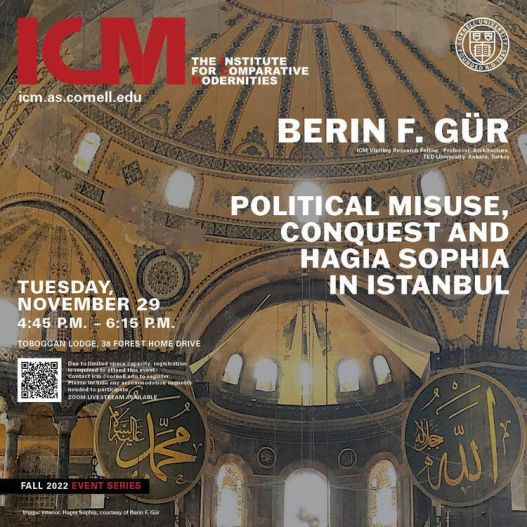
Berin F. Gür, "Political Misuse, Conquest and Hagia Sophia in Istanbul”
November 29, 2022
4:45 pm
Toboggan Lodge
For the Islamist-nationalist circles in Turkey, the conquest of Istanbul on May 29, 1453 is a significant triumph inherited from the magnificent times of the Ottoman Empire, and believed to denote the founding moment of the Turkish nation. In this research, the Islamist-nationalist rhetoric of the Ottoman conquest of Istanbul is seen as a manipulated melancholy project of the Islamist-nationalist imagination, which fixes the conquest in (spatial) images of its own “mourning” and produces “lost objects” to use as a tool of political propaganda (although nothing has actually been lost). Architecture as the bearer of clues to the search for lost objects and spatial-political instruments of the conquest rhetoric thus becomes the subject of the research. Hagia Sophia, whose status as a prayer space (mosque) and secular space (museum) has always been the main issue of controversies, is instrumental in thinking of “the lost mosque”. Thus, in this research, the building is brought forward as “the lost object” of the politically manipulated melancholy project of the Islamist-nationalist imagination, and its political misuse as “the lost mosque” becomes the main focus.
Berin F. Gür is professor of Architecture at TED University (TEDU), Ankara, Turkey and a visiting research fellow at the Institute for Comparative Modernities. She has taught architectural design since 1992 and teaches classes on the spatial and formal analysis of buildings and its theory, reading architectural precedents, and topics in contemporary architecture. She has various publications in the international and national journals and books on the processes of architectural design and urban design; architectural design education; architectural criticism; ideologies and architecture, and the production of urban space. She was the head of TEDU Department of Architecture between 2013-2019; and worked as the Vice Dean between 2019-2021.
Her time at Cornell and the ICM will be spent working on her current book project, Conquest and Melancholy: The Islamist-nationalist Rhetoric of the Conquest of Istanbul and the Manipulation of Architecture. The book brings together two seemingly irrelevant terms: “conquest” associated with glory and victory, and “melancholy” associated with mourning and grief. Togetherness of conquest and melancholy in this book advocates re-conceptualization of melancholy as a manipulated project. And the following questions are formulated: How is the Istanbul’s conquest represented in the Islamist-nationalist imagination? What are the melancholy objects or, in other words, “the lost objects” of the Islamist-nationalist rhetoric of conquest? What are the spatial political instruments of the conquest rhetoric?
Livestream available with this link. No registration required for online viewing:
passcode: 1129
Additional Information
Program
Institute for European Studies
The Great Sanctions Debate

Nicholas Mulder, IES
“While the use of sanctions has surged, their odds of success have plummeted,” says Nicholas Mulder, assistant professor of history, in his book “The Economic Weapon: The Rise of Sanctions as a Tool of Modern War.”
Additional Information
Sino-Italian Encounters in Global Fashion
November 9, 2022
3:00 pm
Uris Hall, G08
The Cornell Contemporary China Initiative (CCCI) of the East Asia Program welcomes Simona Segre-Reinach (Fashion Studies, University of Bologna, Italy) as part of our semester-long theme of Fashion and Politics in Twentieth-Century China with faculty host, Peidong Sun (History, Cornell)
Some of the questions that guest speakers will investigate include: How do we define politics from the dimension of fashion? What was a politicized fashion? How did fashion reflect the power structure? How did fashion become a way of obedience and resistance? And how do we define and interpret the human condition in China under Mao's rule (1949-1976)? What was human resilience in the face of absolute power?
Simona Segre-Reinach's talk is titled, "Sino-Italian Encounters in Global Fashion: 20 Years of Sino-Italian Collaborations."
The talk focuses on the evolution of fashion relations between Italy and China in a unique period - from the late nineties of the 20th century to the second decade of the 21st century – which signals a change in the concept and the practices of Italian fashion on the one hand and the emerging of Chinese fashion withing a global setting on the other.
The CCCI lecture series aims to expose the broad campus community to issues and scholarship of contemporary China.
We thank our co-sponsors:
Asian American Pacific Studies Program | Asian Studies | College of Human Ecology | Cornell Society for the Humanities | Feminist, Gender & Sexuality StudiesDepartment of History | Department of International & Comparative Labor Relations | Department of History | The Levinson China & Asia-Pacific Studies Program
Additional Information
Program
Einaudi Center for International Studies
East Asia Program
Institute for European Studies
Fighting Yesterday's War: Soviet Influences in Putin's Foreign Policy
October 6, 2022
11:25 am
Dr. Maria Snegovaya examines the drivers of Russian revanchism. Russia’s behavior has thrown into doubt the purported strength of international norms regarding territorial integrity, not least because Putin himself has spoken of seeking to ‘re-gather’ adjacent territory deemed ‘lost’—as they had been once under possession by Imperial Russia or the Soviet Union—through military means.
While recognizing that decisions to go to war and to reclaim lost territory are complex and multifaceted, the speaker argues that many analyses overlook—ironically—the nature of the political regime that rules Russia. If domestic political variables do matter for observers of Russia, the emphasis is on how Russia is institutionally autocratic such that it will pursue a foreign policy more aggressive than what would have been the case if it were democratic.
Maria Snegovaya and her co-author define a political regime in both institutional and behavioral terms to acknowledge the structural organization of power as well as the qualities of the elites that exercise influence. They show a strictly institutional definition of political regimes neglects the elite continuity that ties together the Soviet and the Russian leadership. This elite continuity across the two systems matter because the political regime still privileged particular beliefs about the use of force to settle international disputes, the intentions of the United States, and the relationship that certain nations should have vis-à-vis Russia. These beliefs, which they show to hold sway, had their Soviet antecedents.
Please join us for this virtual conversation. Register here.
About Speaker
Maria Snegovaya is a Postdoctoral Fellow in Political Science at Georgetown University's Walsh School of Foreign Service, a Visiting Scholar at the Institute for European, Russian, and Eurasian Studies at George Washington University, and Adjunct Senior Fellow at the Center for New American Security. She is a comparative politics, international relations, and statistical methods specialist. The key focus of her research is democratic backsliding in Central and Eastern Europe, as well as Russia’s domestic and foreign policy.
***
Presented by the Reppy Institute for Peace and Conflict Studies. Co-sponsored by the Institute for European Studies and the Gender and Security Sector Lab.
Additional Information
Program
Einaudi Center for International Studies
Reppy Institute for Peace and Conflict Studies
Institute for European Studies
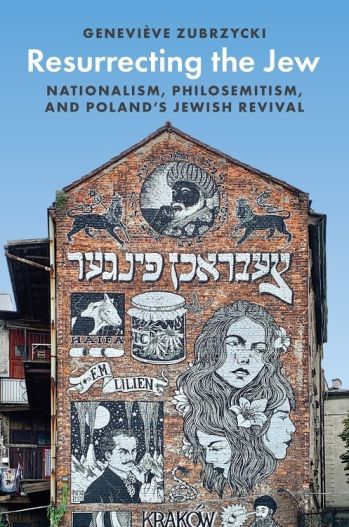
Resurrecting the Jew: Nationalism, Philosemitism, and Poland's Jewish Revival
November 15, 2022
1:00 pm
Uris Hall G08
Since the early 2000s, Poland has experienced a remarkable Jewish revival, largely driven by non-Jewish Poles with a passionate new interest in all things Jewish. Klezmer music, Jewish-style restaurants, kosher vodka, and festivals of Jewish culture have become popular, while new museums, memorials, Jewish studies programs, and Holocaust research centers reflect soul-searching about Polish-Jewish relations before, during, and after the Holocaust. In Resurrecting the Jew, Geneviève Zubrzycki examines this revival and asks what it means to try to bring Jewish culture back to life in a country where 3 million Jews were murdered and where only about 10,000 Jews now live.
Drawing on a decade of participant-observation in Jewish and Jewish-related organizations in Poland, a Birthright trip to Israel with young Polish Jews, and more than a hundred interviews with Jewish and non-Jewish Poles engaged in the Jewish revival, Resurrecting the Jew presents an in-depth look at Jewish life in Poland today. The book shows how the revival has been spurred by progressive Poles who want to break the association between Polishness and Catholicism, promote the idea of a multicultural Poland, and resist the Far Right government. The book also raises urgent questions, relevant far beyond Poland, about the limits of performative solidarity and empathetic forms of cultural appropriation.
Speaker
Geneviève Zubrzycki, Professor of Sociology at the University of Michigan
Register for the session here.
Additional Information
Program
Institute for European Studies
Italy’s Government Is in Turmoil. Here’s How It Got There – and What’s Next
Christopher Way, IES/PACS
"Mario Draghi was such a trusted pair of hands across Europe," says Christopher Way, associate professor of government. "He was so respected for his competence that it's a loss no matter who replaces him."