
Southeast Asia Program
Cambodia's Angkor Temples as a Military Prize: The World War II Experience

February 25, 2021
12:30 pm
Part of the Ronald and Janette Gatty Lecture series
John Burgess, independent author and journalist, former Washington Post journalist and author of Angkor's Temples in the Modern Era: War, Pride, and Tourist Dollars
Angkor, capital of the Khmer Empire for close to six centuries, has had a rich and varied history since the French reintroduced it to the outside world in the 1860s. Amateur archaeology, steamboat tourism, the temples’ emergence as a symbol of the Cambodian nation, and repeated military struggles for control of the site have shaped its past century and a half. Angkor’s ability to draw people from beyond Cambodia’s borders has resulted in conservation and economic gain but also in conflicts, both among the foreigners and with Cambodians for whom Angkor was and is home.
Additional Information
Program
Einaudi Center for International Studies
Southeast Asia Program
Beyond Bloody Reds: Notes on the Significance of Morinda in the Bagobo Textile Hierarchy

February 18, 2021
12:30 pm
Part of the Ronald and Janette Gatty Lecture series
Cherubim Quizon, Associate Professor of Anthropology in the Department of Sociology, Anthropology, Social Work and Criminal Justice, Seton Hall University
The magical and spiritual power of red cloth has a long and complex story in the Philippines and Southeast Asia. The revolutionary reds in flags, banners and amulets that sustained indigenous bodies in colonial struggles have been broadly approached through the lens of history and philology. Depending on political exigency, they are associated with valor or insurrection; when approached as antiquities, they are valued as chiefly markers often mapped to the killing of men. How do these ideas hold up when understanding the significance of red cloth among indigenous peoples in Mindanao? Focusing on Bagobo textile practices, the paper suggests that the dye plant Morinda sp. when applied to indigenous thread creates conditions that metonymically and procedurally link redness with effort and efficacy that operates within a larger indigenous semantic category of prestige cloths. Comparing Mindanao textile practices to Indonesia and Malaysia suggest broader semantic implications. In seeking to expand semiogenesis beyond the anecdotal dependence on redness and bloodshed that has dominated the literature on Bagobo “warrior” textiles, this paper argues that perspectives from the domain knowledge of the women who make such cloths provides a more robust understanding of textiles as material culture practice in general, and the meanings that we can reasonably associate with indigenous cloth and dress in particular.
Additional Information
Program
Einaudi Center for International Studies
Southeast Asia Program
Old Thai and the Arrival of Thai in Central Thailand

February 12, 2021
8:00 pm
Part of the Ronald and Janette Gatty Lecture series
Pittayawat (Joe) Pittayaporn, Associate Professor, Department of Linguistics; head of the Southeast Asian Linguistics Research Unit, Faculty of Arts, Chulalongkorn University
The linguistic landscape of central Thailand prior to the 13th century was radically different from today. It is generally believed that the area was pre-dominantly Mon-Khmer speaking. O’Connor (1995) suggests that the Tai migration into Southeast Asia started in the first millennium A.D. Diller (2000) similarly suggests that the southwest-ward migration of Tai speakers started in the 10th century. In this talk, I discuss when and how Old Thai, the language attested in 14th-15th century inscriptions, came to replace aboriginal languages of the area. By examining its development from Proto-Southwestern Tai (Pittayaporn 2009), I argue that Old Thai was first spoken in central Thailand some time before the oldest surviving Thai text was inscribed, perhaps in the 13th century. In addition, I hypothesize based on linguistic and genetic evidence that the Thai language came to dominate central Thailand mainly through migration of Tai-speaking population, rather than ethnolinguistic assimilation of indigenous non-Tai speakers.
Additional Information
Program
Einaudi Center for International Studies
Southeast Asia Program
FLAS Deadline March 3!
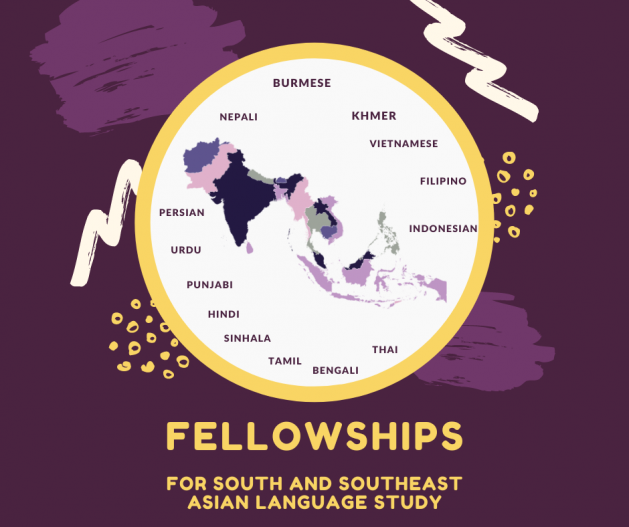
Apply now through March 3 for a Foreign Language and Area Studies (FLAS) Fellowship!
Find out how FLAS can support your studies and language learning!
Additional Information
Info Session: Fulbright U.S. Student Program for Undergraduates
April 12, 2021
4:30 pm
The Fulbright U.S. Student Program supports college graduates conducting research or teaching in any field in more than 150 countries. Applications are due in the fall; students who wish to begin the program immediately after graduation are encouraged to start the process in their junior year.
United States citizens in any field of study are eligible.
Contact: fulbright@einaudi.cornell.edu, https://einaudi.cornell.edu/fulbright-us-student-program
Additional Information
Program
Einaudi Center for International Studies
Reppy Institute for Peace and Conflict Studies
East Asia Program
Southeast Asia Program
Latin American and Caribbean Studies
Institute for African Development
Institute for European Studies
South Asia Program
Info Session: Fulbright U.S. Student Program for Undergraduates
March 3, 2021
4:30 pm
The Fulbright U.S. Student Program supports college graduates conducting research or teaching in any field in more than 150 countries. Applications are due in the fall; students who wish to begin the program immediately after graduation are encouraged to start the process in their junior year.
United States citizens in any field of study are eligible.
Contact: fulbright@einaudi.cornell.edu, https://einaudi.cornell.edu/fulbright-us-student-program
Additional Information
Program
Einaudi Center for International Studies
Reppy Institute for Peace and Conflict Studies
East Asia Program
Southeast Asia Program
Latin American and Caribbean Studies
Institute for African Development
Institute for European Studies
South Asia Program
Info Session: Einaudi Center Regional and Thematic Minors
April 5, 2021
4:30 pm
Take your learning to the next level with regional and thematic minors from the Mario Einaudi Center for International Studies and our programs. Whatever your major and career goals, our wide geographical reach and interdisciplinary focus provide opportunities for you to expand your global knowledge and broaden your approach to your studies and the world. Find out if an Einaudi Center minor is right for you and how to apply.
Co-sponsored by the Tatkon Center for First-Year Students
Contact: einaudi_center@einaudi.cornell.edu; https://einaudi.cornell.edu/learn/minors-and-academics
Additional Information
Program
Einaudi Center for International Studies
Southeast Asia Program
Latin American and Caribbean Studies
Institute for European Studies
South Asia Program
East Asia Program
Institute for African Development
Info Session: Careers Beyond Academia - Resources for PhD students and Postdocs
March 24, 2021
4:30 pm
Explore options beyond academia and discover how to make informed decisions for career choices in government, non-profits and industry. Test-drive career opportunities through career panels, individual and group sessions, site visits and more. Visit website for more details.
Contact: sap@cornell.edu
Additional Information
Program
Einaudi Center for International Studies
East Asia Program
Southeast Asia Program
Latin American and Caribbean Studies
Institute for European Studies
South Asia Program
Institute for African Development
Info Session: International Relations Minor
February 25, 2021
4:45 pm
Is the Einaudi Center's International Relations minor for you? Here's a chance to find out. Graduates go on to successful careers in fields like international law, economics, agriculture, trade, finance, journalism, education, and government service.
Contact: irm@einaudi.cornell.edu; https://einaudi.cornell.edu/academics/international-relations-minor
Additional Information
Program
Einaudi Center for International Studies
Reppy Institute for Peace and Conflict Studies
East Asia Program
Southeast Asia Program
Latin American and Caribbean Studies
Institute for African Development
Institute for European Studies
South Asia Program
Info Session: Summer Language Programs and Funding Opportunities
February 17, 2021
4:30 pm
Want to learn a language this summer? Learn about Foreign Language and Area Studies fellowships and Critical Language Scholarships, which provide fully funded opportunities for Cornell undergraduate and graduate students to study South and Southeast Asian languages in the summer, and even in the academic year.
Additional Information
Program
Einaudi Center for International Studies
Southeast Asia Program
South Asia Program