
Southeast Asia Program
Southeast Asia Digital Librarian Hired to Fill a New Role at the Library
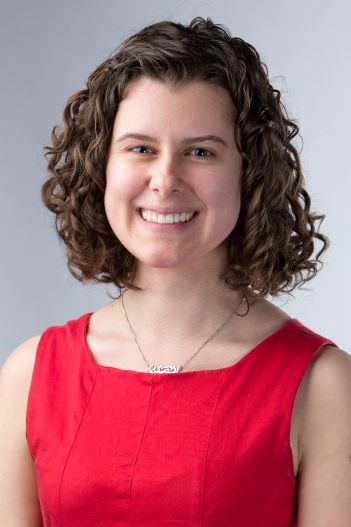
Cornell University Library and the John M. Echols Collection on Southeast Asia are happy to announce the hire of Emily Zinger to fill the position of Southeast Asia digital librarian.
Ms. Zinger graduated with her master’s degree in Information Studies from McGill University. While at McGill she worked for the university’s Rare Books and Special Collections Library as a metadata manager for two digital humanities research projects. She has previously worked as the junior editor of the Dewey Decimal Classification at the Library of Congress. Zinger received her bachelor’s degree from the College of William & Mary.
This new position will support the growth of digital library holdings in Southeast Asian Studies among the libraries with Southeast Asia collections in the United States, and in some cases, similar collections internationally. The position is initially funded by the Henry Luce Foundation as part of a project called The Southeast Asia Digital Library: A new approach to building and curating a digital library. Based in the John M. Echols Collection on Southeast Asia, the Southeast Asia digital librarian reports to the curator of the Echols Collection.
This person will have responsibility to coordinate digital library work between the Echols Collection, other departments within Cornell University Library, participating library partners, including Ohio University Library (overall grant administration), Northern Illinois University Library (host of the Southeast Asia Digital Library) and other participating institutions. The Southeast Asia digital librarian actively participates in local and national discussions relating to the access, retrieval, description, and management of shared digital resources in the field of Southeast Asian Studies.
Additional Information
Program
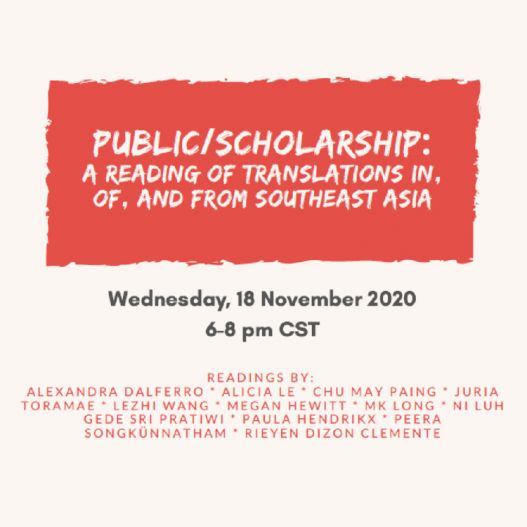
PUBLIC/SCHOLARSHIP: A Reading of Translations in, of, and from Southeast Asia
November 19, 2020
7:00 pm
Since September, approximately thirty graduate students working inside and outside the university around the world met every other week to read and think critically and politically about translation and movement in language in and in opposition to Southeast Asian Studies. How do the colonial, imperial and Cold War legacies in the field shape knowledge, and how might we resist it? What are the potential places of translation in a scholarly life and in a public life, and how do they intersect and diverge? Simultaneously, we circulated and workshopped our own translations of poems, short stories, archival documents, journal articles, and dissident manifestos with one another. In this reading, members of the workshop share their translations with you.
Readings by: alexandra dalferro, Alicia Le, Chu May Paing, Juria Toramae, Lezhi Wang, Megan Hewitt, MK Long, Ni Luh Gede Sri Pratiwi, Paula Hendrikx, Peera Songkünnatham, Rieyen Dizon Clemente
With support from the Department of Asian Languages and Cultures and the Center for Southeast Asian Studies at UW-Madison and the GETSEA Consortium.
Additional Information
Program
Einaudi Center for International Studies
Southeast Asia Program
Anthropology Colloquium: Alexandra Dalferro
November 20, 2020
3:00 pm
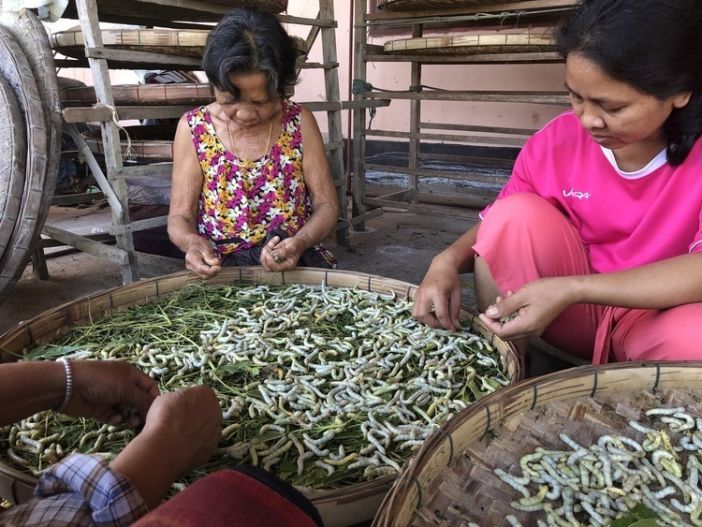
Silky Bodies: Nation-Making and Historical and Contemporary Practices of Caring for Silkworms in Thailand
Alexandra Dalferro is a PhD student in Sociocultural Anthropology. Her research focuses on the politics, practices, and history of silk production in Thailand, particularly among Khmer communities in Surin Province.
She is interested in how knowledge and identity claims are fashioned and contested through material processes, and she foregrounds silk's "shimmering surfaces" to think about the affective and sensory dimensions of weaving and sericulture.
Before coming to Cornell, Alexandra lived in Thailand for over 4 years, working as a Research Assistant at the Sirindhorn Anthropology Centre and as an intern at UNESCO-Bangkok. She also completed one year of research as a Fulbright Student Researcher on the legal lottery system in Thailand and the precarious positions of migrant ticket sellers. She holds a BA in East Asian Languages and Cultures from Columbia University.
Additional Information
Program
Southeast Asia Program
Deadline Extended: SEAP Graduate Student Conference

We are pleased to announce the 23rd Cornell SEAP Graduate Student Conference, entitled "Links and Fractures." The conference will be held virtually from March 19 to March 21, 2021. The call for papers is below, and available here.
The time of global pandemic presented many obstacles for communities engaged with Southeast Asia to stay connected and thrive. At the same time, the limitations upon meeting in person or conducting fieldwork inspired new ways to forge dialogs, shake old conventions, and embrace creative, often technological, change. As graduate
students, we witnessed a boom of new and revamped platforms that emerged to connect those separated geographically by COVID-19 and enable academic, social, and professional relations. On the other hand, physical limitations within our communities have produced severe economic and personal fractures that have not yet been remediated. These patterns of Links and Fractures have long existed before COVID-19 in Southeast Asia, arising out of historical processes of colonization and decolonization, religion, commodity and cultural exchanges, migration, language, information technology, economic expansion, social unrest, political upheaval, and more. Within these patterns are both opportunities and losses for a wide range of diverse Southeast Asian communities, creating “new normals” before the “new normal” instigated by COVID-19.
For the 23rd annual Southeast Asia Program Graduate Student Conference, we invite submissions that explore how these Links and Fractures have shaped communities in Southeast Asia. Specifically, we are seeking PhD and Master student-level research united by this common theme across all academic disciplines. During the conference, we also hope to foster new ways of circulating and engaging with your research within the conference community and Cornell SEAP faculty.
The Graduate Student Conference will be held March 19-21, 2021 online (pending Cornell Spring 2021 Academic Calendar) catering to the opportunity to bring together participants and attendees from all over the world, and powered by SEAP web-platforms. Over an immersive three-day period, the Graduate Student Conference will facilitate sharing your research with Cornell SEAP faculty, academics and fellow peers within the graduate community. Contributors will present their work as part of a panel with faculty discussants and have a dedicated page within our online platform to discuss their work with a broad participant audience.
We welcome submissions of abstracts by December 30th, 2020 at 11:59pm EST from graduate students who have completed original research related to Southeast Asia. The Cornell Southeast Asia Program’s Graduate Student Committee will review the abstracts, select presenters, and organize panels by theme. In order to aid the process of thematic organization, we ask that you please include a few keywords summarizing your presentation along with your abstract. Presenters should be prepared to submit full papers of 5000-8000 words by February 12th, 2020.
Please submit abstracts to the following email address: seapgatty@cornell.edu All abstracts should be limited to 250 words and sent in .doc or .docx format. Do not send a PDF. Please name your abstract using your first and last name together (for example, janedoe.doc for Jane Doe's abstract).The subject of the message should specify “SEAP Graduate Conference Submission” and the body of the email should include the following information: · Author name(s), institutional affiliation(s), and a primary email address · Title of paper · Paper keywords · The abstract (attached as a .doc or .docx file)
We thank you for your interest, and hope to create a Link with you in a time of increasing Fractures.
Anna Koshcheeva and Kara Guse,
Cornell SEAP Graduate Student Committee Co-Chairs (2020-2021)
seapgatty@cornell.edu
Additional Information
SEAP welcomes new faculty: Juno Salazar Parreñas

Juno Parreñas is an ethnographer working at the intersections of human-animal relations, decolonization, and environmental justice.
After completing her Ph.D. in Anthropology at Harvard University in 2012, she was an Agrarian Studies Postdoctoral Research Fellow at Yale University and a Postdoctoral Research Fellow with the Rutgers Center for Historical Analysis. In 2014 she became an Assistant Professor in Women’s, Gender, and Sexuality Studies at Ohio State University and remained there until joining us at Cornell this fall as an Assistant Professor in Science and Technology Studies and Feminist, Gender and Sexuality Studies.
Parreñas’ scholarly interests in conservation biology, animal behavioral sciences, history, science studies, colonialism, queer theory, anthropology, and feminist studies are expressed in her book Decolonizing Extinction: The Work of Care in Orangutan Rehabilitation (2018). It received the 2019 Michelle Z. Rosaldo Book Prize from the Association for Feminist Anthropology as well as honorable mentions for the 2020 Harry J. Benda Prize from the Association for Asian Studies, the 2019 Diana Forsythe Prize from the Society for the Anthropology of Work and the Committee for the Anthropology of Science, Technology, and Computing, as well as the 2019 New Millennium Award from the Society for Medical Anthropology.
Her new project, “Who Gets to Retire? Human-Animal Life Histories of Labor” looks at the emergence of animal retirement and geriatric veterinary care around the world as a way to think about global political economy and thresholds between life, death, and work. Parreñas is also looking forward to developing new courses, and starting this spring 2021 she will teach “Environmental Ethics” for Biology and Society majors and the graduate level proseminar in Feminist, Gender, and Sexuality Studies, which will foster discussion on emerging themes in interdisciplinary feminist studies.
Ever since she came to Cornell in fall 2015 to present a Gatty Lecture, she has sipped tea from her Cornell mug and looked forward to joining the vibrant and collaborative community here. SEAP is likewise excited to welcome her as the newest SEAP faculty member.
Additional Information
Program
Wrong Again! Just like 2016, Pollsters Across America Missed the Mark with U.S. Elections
Thomas Pepinsky, SEAP/SAP
"We’re not yet at the stage where we can diagnose exactly what went wrong with the polls in this cycle,” says professor of government Thomas Pepinsky. “I think it’s clear that the polling industry in aggregate is going to have to study the results because there are some big misses.”
Additional Information
70th Anniversary Well Underway
SEAP continues to celebrate its 70th anniversary.
SEAP launched its 70th anniversary celebrations with a kickoff in early September. The event drew 106 friends and colleagues, current and former staff, current students and alumni, that evening (or morning depending on where you were), tuning in from all over the U.S., as well as from the Philippines, Germany, Indonesia, Singapore, Hong Kong, Pakistan, Thailand, Canada, Japan, China, Australia, France, the UK, Korea, and Malaysia. If you were unable to attend, check out the video here!
This year's SEAP Bulletin is a special issue featuring a wealth of stories about the history of the program, including a reflection on the history of the Lauriston Sharp Prize.
The SEAP Photography Archive is also moving forward, having gathered several hundred photographs representing the intellectual and social life of SEAP across its history. Faculty, staff, alumni, and friends have sent in scans of images (and in some cases entire albums) of their time with SEAP, and we welcome further submissions here.
Two virtual exhibits exploring aspects of SEAP's history are also in progress.
"(Re)collecting: SEAP 70th Anniversary at the Johnson Museum" will use the collections at the Johnson Museum to foreground the materialities and histories of individual objects. The exhibit is scheduled to open in December 2020, with a second phase opening in Spring 2021. For the second phase, we welcome SEAP alumni and friends to share memories and stories that you may have about your engagements and encounters with objects from Southeast Asia in the Johnson collections. If you have stories to share, please do so here.
"Building a Collection: Giok Po Oey and the John M. Echols Collection" will explore the history of the Echols Collection and its first curator, Giok Po Oey. This exhibit is scheduled for Spring 2021, and also welcomes contributions from SEAP alumni, friends, and other scholars.
Additional Information
Program
The Police and the Public: Global Perspectives (Lund Critical Debate)

December 9, 2020
6:30 pm
Protests against racism and police violence crescendoed in the United States and around the world in 2020. In the United States and internationally, how can we balance social justice, accountability, and personal freedom with demands for order and security?
This Lund Critical Debate brings together the United Nations’ police commissioner and a noted expert on political conflict resolution to discuss strategies—both inside and outside the policing framework—for public safety and law enforcement. The conversation will address current questions around security and policing, including political violence, racial injustice and Black Lives Matter, and global responses to unlawful use of force.
The panel welcomes questions in advance and during the event. Registration is required.
Panelists
Luís Carrilho, United Nations Police Adviser. He has served since November 2017 as police commissioner and director of the UN’s Police Division. He previously served as the police commissioner in multidimensional United Nations peacekeeping operations in Timor Leste, Haiti, and the Central African Republic.
Christian Davenport, Professor, Department of Political Science and Public Policy, University of Michigan. His research focuses on racism, social movements, and political conflict, including human rights violations, genocide, torture, political surveillance, and civil war. His most recent book is The Peace Continuum: What It Is and How To Study It (Oxford University Press, 2018).
Moderator
Sabrina Karim, Reppy Institute for Peace and Conflict Studies; Hardis Family Assistant Professor for Teaching Excellence, Department of Government, A&S. Her research focuses on conflict and peace processes, international involvement in post-conflict security, and state building in the aftermath of civil war.
About the Debate
This year’s Lund Critical Debate is hosted by the Mario Einaudi Center for International Studies and Reppy Institute for Peace and Conflict Studies, part of the Einaudi Center. Established in 2008, the Einaudi Center's Lund Critical Debate Series is made possible by the generosity of Judith Lund Biggs ’57.
Additional Information
Program
Einaudi Center for International Studies
Reppy Institute for Peace and Conflict Studies
East Asia Program
Southeast Asia Program
Latin American and Caribbean Studies
Institute for African Development
Institute for European Studies
South Asia Program
Emiko Stock

Faculty Associate in Research
Emiko Stock is a visual and historical anthropologist. Working with Chams (Cambodian Muslims) and Sayyids (descendants of the Prophet Muhammad), she traces passages between Sunnism and Shi’ism and Cambodia and Iran as a practice of history refracted in still and moving images. Her projects, embedded in experimental ethnography, grow from the theorization and practice of analog as well as digital photography and videography. She is currently based in Phnom Penh, developing two projects, a film and a book, each asking how we see history in affective and haptic manners.
Additional Information
The Center for Khmer Studies Highlights SEAP
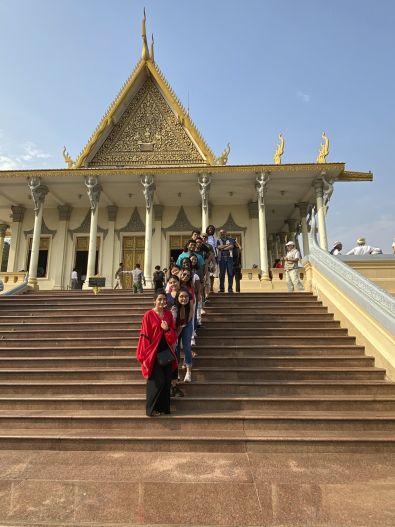
The Center for Khmer Studies recently featured this story from our winter session course in Cambodia. Stay tuned for future winter session trips to Cambodia, which offer Cornell students a chance to explore Cambodian culture and history with hands-on, in-country instruction.
Professors Sarosh Kuruvilla of the School of Industrial and Labor Relations and Vida Vanchan of Buffalo State University brought a group of 11 students to Cambodia during the winter semester to study the role of labor in the Cambodian garment industry. Their objective was to understand the growth of the Cambodian garment industry and how this growth has affected workers' lives.
Following an introduction to Cambodian history, politics, and society at lectures organized by the Center for Khmer Studies, students met with major stakeholders involved with labor issues in garment factories, including senior government officials, such as the Minister of Labor, the Minister of Social Welfare and senior officials from the Ministry of Economy and Finance. Students also met with representatives from the Cambodian Labor Confederation, the Garment Manufacturers Association, and the Cambodian Solidarity Center. A highlight of their experience was talking with Cambodian workers in their homes. After an introduction to Cambodian culture, history, and daily life at CKS, these hands-on experiences provided direct insight into the central role of labor in Cambodia's development and into contemporary labor issues in its garment industry.