
Reppy Institute for Peace and Conflict Studies
Rebecca Slayton
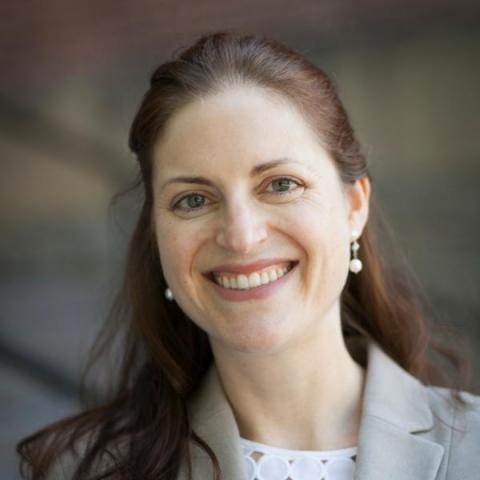
Director, Reppy Institute for Peace and Conflict Studies
Additional Information
Program
Role
- Faculty
- PACS Core Faculty
- PACS Director
- PACS Steering Committee
- PACS Minor Field Instructor
- Einaudi Faculty Leadership
Contact
Email: rs849@cornell.edu
Phone: 607-255-8914
Oct. 1: The Predatory Sea
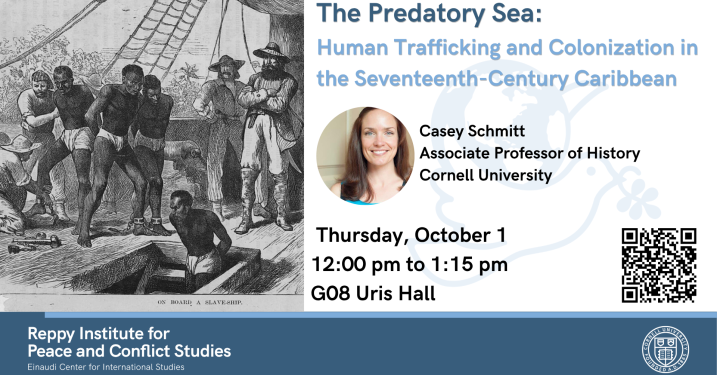
Through extensive research in Spanish, French, and English archives in Europe and the Caribbean, The Predatory Sea offers a fresh perspective on how captivity and maritime violence shaped early English, French, and Dutch settlement.
Unsettling Sovereignty: International Law, Nuclear Weapons, and U.S. Extraterritorial Power in Postwar Oceania

Book
30.00
Additional Information
Program
Type
- Book
Publication Details
Publication Year: 2026
ISBN: 9780226852492
Sept. 24: Private Military Companies (PMCs) and Peacekeeping
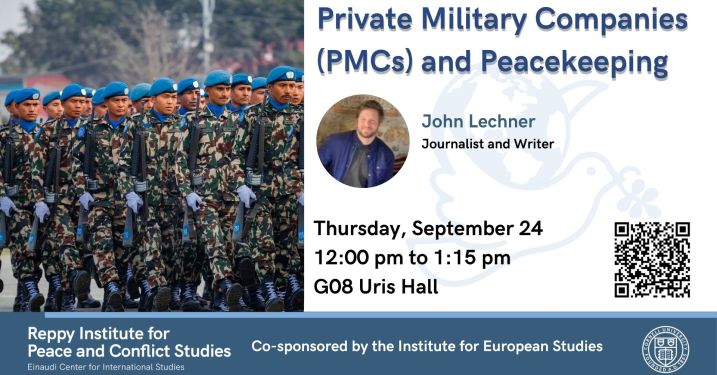
In the late 1990s, a new private military company (PMC) from South Africa, Executive Outcomes, intervened in Angola and Sierra Leone, where the company's operations ushered in a ceasefire.
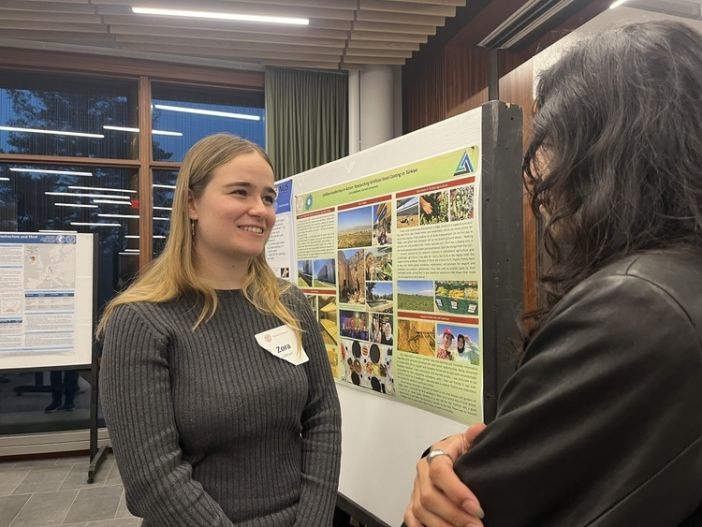
International Research Showcase
October 28, 2026
4:30 pm
Physical Sciences Building, Baker Portico & Atrium
Meet Cornell's Laidlaw scholars and Global Interns at our fall showcase. They'll present their undergraduate international summer experiences, including hands-on research and leadership-in-action.
The International Research Showcase is hosted by the Einaudi Center for International Studies and cosponsored by the Office of Global Learning. Both are part of Global Cornell.
***
Applications for Global Internships and the Laidlaw Leadership and Research Program will open in the fall semester.
Global Internships give undergraduate students valuable international experience in fields spanning global development, climate and sustainability, international relations, communication, business, governance, and more. They are managed by the Einaudi Center for International Studies and Office of Global Learning, both part of Global Cornell.
The Laidlaw Undergraduate Leadership and Research Scholarship Program provides generous funding to first- and second-year undergraduates over two years as they pursue internationally focused research, engage in leadership training and a leadership-in-action experience, and join a global network of like-minded peers. The program is managed by the Einaudi Center.
Additional Information
Program
Einaudi Center for International Studies
Reppy Institute for Peace and Conflict Studies
East Asia Program
Southeast Asia Program
Latin American and Caribbean Studies
Institute for African Development
Institute for European Studies
South Asia Program
Migrations Program
Southwest Asia and North Africa Program
Faculty Research Seed Grants: Global Hubs Info Session
September 24, 2026
9:00 am
Drop in to learn more and ask questions about the 2027 Global Hubs Faculty Research Seed Grants that Global Cornell and partner universities are offering through the Global Hubs initiative.
Join us on Zoom at any time during the session.
Through these seed grants, Cornell faculty from across the university are invited to apply for research funds to explore and jumpstart collaborations with colleagues at Global Hubs partner institutions. Funded projects should lead to tangible outcomes, including the submission of at least one co-authored peer-reviewed publication and at least one application for external grant funding.
Successful proposals will receive up to $5,000 from Cornell, with the potential for matching funds from some Global Hubs partner universities.
Application deadline: October 14, 2026, 4:00 p.m. ET
Project duration: January 1–December 31, 2027
Learn more and apply for a Global Hubs joint seed grant.
Additional Information
Program
Einaudi Center for International Studies
Latin American and Caribbean Studies
Reppy Institute for Peace and Conflict Studies
East Asia Program
Southeast Asia Program
Institute for African Development
Institute for European Studies
South Asia Program
Migrations Program
Southwest Asia and North Africa Program
Information Session: Global Internships
October 15, 2026
4:30 pm
Uris Hall, G08
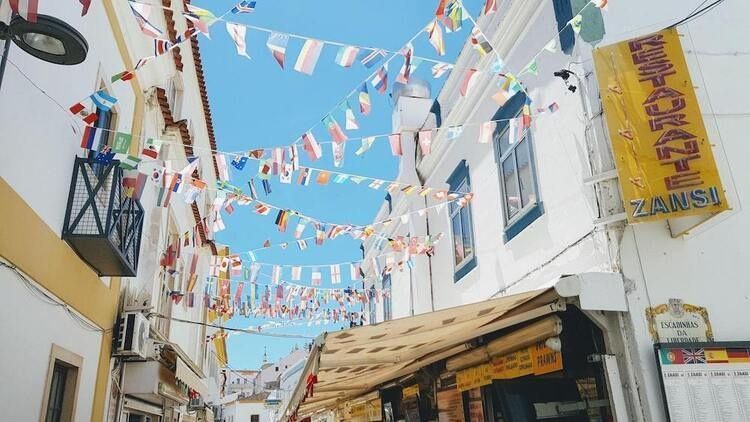
Go global in summer 2027! Global Internships give you valuable international work experience in fields spanning global development, climate and sustainability, international relations, communication, business, governance, and more.
Applications are open now.
Can’t attend? Contact programs@einaudi.cornell.edu.
***
The Mario Einaudi Center for International Studies hosts info sessions for graduate and for undergraduate students to learn more about funding opportunities, international travel, research, and internships. View the full calendar of fall semester sessions.
Additional Information
Program
Einaudi Center for International Studies
Reppy Institute for Peace and Conflict Studies
East Asia Program
Southeast Asia Program
Latin American and Caribbean Studies
Institute for African Development
Institute for European Studies
South Asia Program
Migrations Program
Southwest Asia and North Africa Program
From the Blue Box to Hacks-and-Leaks: The Entanglements of Hacking and Journalism
October 22, 2026
11:45 am
Bill and Melinda Gates Hall, G01
Over the past several decades, hacking and journalism have increasingly intersected, changing how both fields work. This talk uses that relationship as a way into hacking itself: its different cultures, histories, and politics. Hacking has never been one thing—phreaks, free software developers, the underground, security researchers, artist- activists—each with their own ethics and histories. The media, however, has usually focused on just one group at a time, and which group got attention often depended on the political milieu. At first, journalists mostly treated hackers as threats or oddities. Later, as technology became more widespread and complex, journalists began to seek out hackers for their expertise. Sometimes reporters approached these experts, but hackers also made themselves visible and available to journalists. They had shared their knowledge for years in zines like 2600 and Phrack, and groups like the L0pht and the Chaos Computer Club staged public interventions to force media coverage. I will end by discussing what changed after 2010, when hackers began doing journalism themselves through leaking and hacking. Newsrooms had to re-work out the ethics of publishing stolen material and of depending on sources they were still uneasy about.
About the speaker
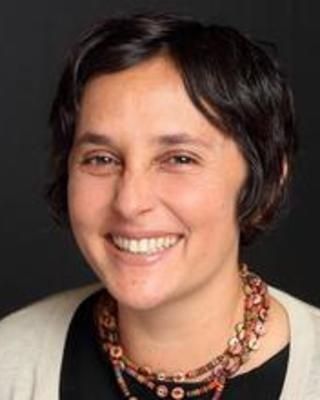
Gabriella (Biella) Coleman is a full professor in the Department of Anthropology at Harvard University and is a faculty associate at the Berkman Center for Internet and Society. Trained as an anthropologist, her scholarship covers the politics, cultures, and ethics of hacking. She is the author of two books on computer hackers and the founder and editor of Hack_Curio, a video portal into the cultures of hacking).
Host
Computer Science Colloquium Series
Co-host
Reppy Institute for Peace and Conflict Studies, part of the Einaudi Center for International Studies
Additional Information
Program
Einaudi Center for International Studies
Reppy Institute for Peace and Conflict Studies
Tim Cook Hands Apple Reins to John Ternus, but Remains Trump Whisperer

Sarah Kreps, PACS
Sarah Kreps, director of the Tech Policy Institute at Cornell Brooks School of Public Policy, comments on Apple's decision to appoint a product-focused CEO to accelerate AI development.
Additional Information
Motoyuki Yoshihara
Evangelista Fellow 2026-27
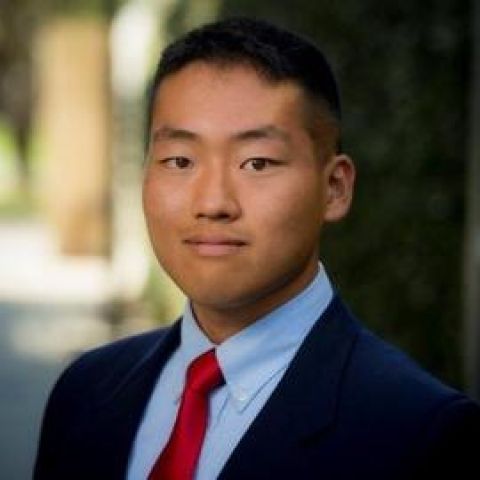
Moto Yoshihara is a PhD student at the Dyson School of Applied Economics and Management and the inaugural Dick and Rosalie Bush Fellow of Economic Warfare at the U.S. Air Force Academy. His work sits between academic economics and contemporary statecraft, examining how emerging economic weapons reshape the conflicts they are meant to influence, and what their second-order consequences mean for the policymakers who wield them. A practitioner as well as a scholar, he has served in a range of roles across more than a decade in the U.S. Army.